We’ve just had a general election but before I begin the history of UK enfranchisement, here’s a quick quiz. Who are the following and what’s their link? Obviously, they’re all relevant to the topic or I wouldn’t be asking…
Emily Wilding Davison
Henria Williams
Mary Clarke
Thomas Aston
Richard Boothman
Emily Wilding Davison is the easiest to identify. She was the suffragette killed by the King’s horse at the Epsom Derby on 8 June 1913. Much has been written and hypothesised about Wilding, this incident, her return rail ticket and whether she was martyr or victim of tragic mistiming but whichever conclusion you take, Emily Davison died in the struggle for female enfranchisement.
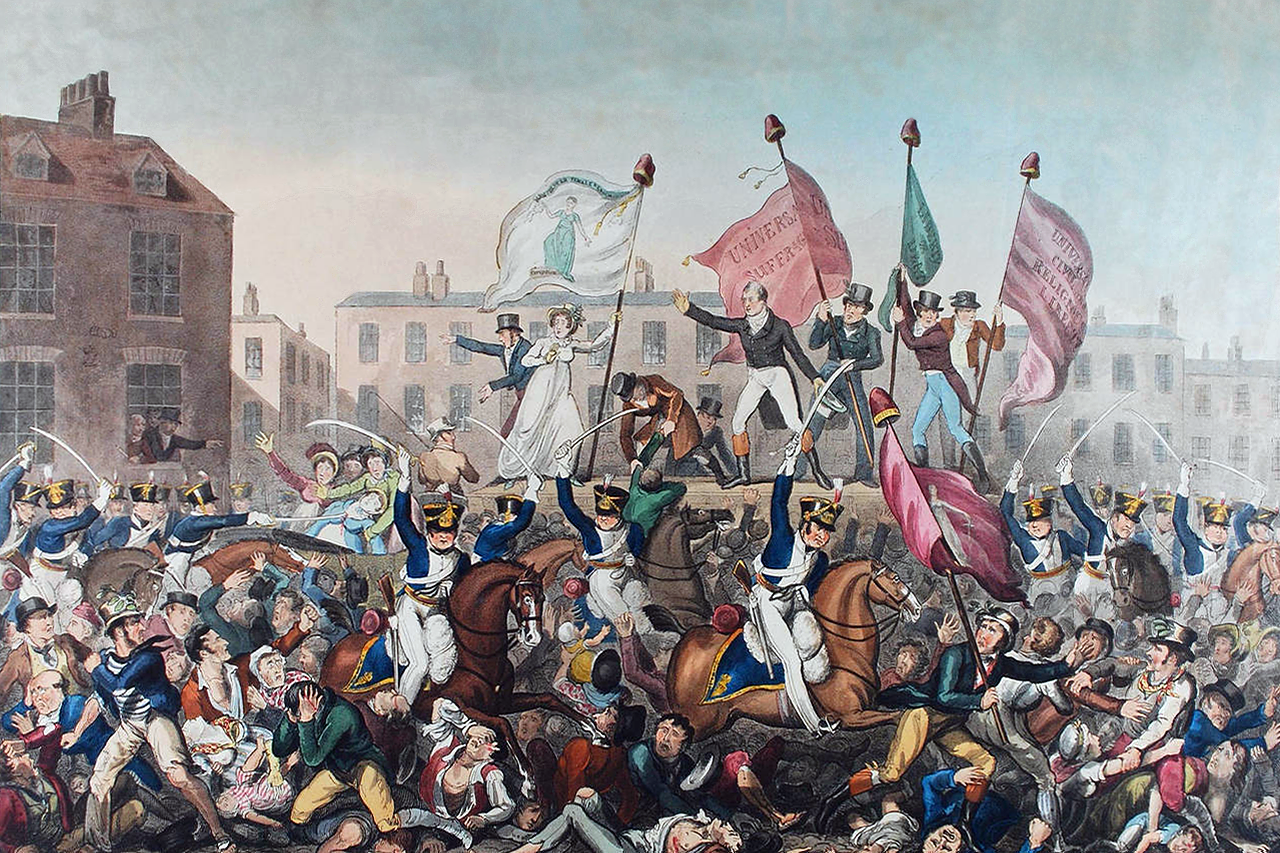
The date for the demand for universal suffrage is debateable and in the early years of universal enfranchisement it essentially meant enfranchisement for men not women. It was certainly on the agenda by the early 1800s. Take the Peterloo Massacre for example. A huge open-air meeting was organised where orator and radical Henry Hunt was to speak at St Peter’s Field, Manchester on 16th August 1819 (I attended the 200th commemoration). His topics included causes such as the repeal of the corn laws and universal suffrage. Attending on the day and clearly seen wearing white at his side on the cart he used to address the crowds were a number of women who also supported universal suffrage – for men. That women could have the vote was, at this time, deviant. Statistics for the size of the crowd, many of whom had walked several miles to hear him speak from, for example, Rochdale, Ashton under Lyne and Stockport, range between 60,000 to 100,000. Fearing political turmoil, the magistrates turned the dragoons and militia on the peaceful rally and statistics for the victims range from 11-20 for those who died on site or a few days/weeks later from their injuries plus 400-700 other casualties many of whom kept their injuries secret in case their employers found they had been there and dismissed them. All because ‘common people’ dared to want a change in the way the government was run and their representation within it. By the 1860s, the concept that women should also be enfranchised began to gain momentum but in the early years, this was generally regarded with consternation or downright hostility.
Known today as the Great Reform Act, The Representation of the People Act was passed in 1832. This momentous Act of Parliament abolished the Rotten Boroughs – constituencies which had a very small electorate but one or two MPs. Electors were often bribed with enormous sums of money to vote for one man or another. The most infamous constituency was Old Sarum in Wiltshire which had 3 houses, 7 on the electoral roll, tens of thousands of sheep and 2 MPs.
On the other hand, Manchester in 1831 had a population of 700,000 and no MP. Following the 1832 Reform Act, it was awarded two. Birmingham was another city which didn’t return an MP until 1832. Even though its population was just short of 147,000 in 1831 it was only awarded one MP in the Act. The 1832 Reform Act may have created 67 new constituencies, disenfranchised 56 others and reduced 31 to one MP but it didn’t widen enfranchisement. The only permitted voters were male (women were specifically excluded) who owned land, tenant farmers, shopkeepers and renters of property worth over £10 a year.
This rankled with a lot of men and by the late 1830s, the Chartist Movement supporting more democracy and parliamentary reform became popular. The Charter, which gave the movement its name, demanded 6 points:
- A vote for every man over 21. Finally conceded under the 1918 Representation of the People Act; married women over 30 whose husband owned property also gained the vote. All women over 21 were enfranchised in 1928. Ironically, suffragette Emmeline Pankhurst died 28 June 1928 a few weeks before the law was passed. Suffragiste Millicent Fawcett, on the other hand, lived to see the day and was guest of honour at a breakfast held at London’s Cecil Hotel celebrating women’s equal enfranchisement.
- Secret Ballot (prior to this, those on the electoral register literally had to stand and be counted). The Secret Ballot Act was passed in 1872 and the first election held under this ruling was the Pontefract by-election 15 August 1872. It did not go to plan – see
- No property qualification. Since 1711, a prospective MP had to own property worth at least £600. Several men who won seats were disqualified for not owning enough property eg Feargus O’Connor in 1835. The requirement was repealed in 1858.
- Payment of MPs. Obviously, poor candidates would not consider standing for parliament. And if they became an MP and lost their income, working men wouldn’t stand either. Payment for MPs was passed as recently as 1911 under Herbert Henry Asquith’s Liberal Government. They received £400 a year. Today, a UK back bencher earns £91,346 plus expenses to cover their office, the staff to run the office, London accommodation if they live elsewhere and travelling expenses between London and their constituency.
- Constituencies of equal size. Refer back to Old Sarum above! In 2023, the borders of our constituencies were changed again to make electoral numbers more equitable. We only need to look at population increase under decennial census records to see how fast the UK population has grown. In 1801, it was estimated at 8.9 million. By 1841 it was over 18 and a half million. By 1881 it was not far short of 30 million. There were 50 million in 1950 and over 67 million today. The first attempt at addressing constituency size was under the Redistribution of Seats Act, 1885.
- Annual Parliaments. This is the only point which has not come to fulfilment. The current rules are that a government must call a general election within five years of its coming to power.
This leads me back to the men’s names at the top of this article. Thomas Aston and Richard Boothman were Chartists and two of 100 transported to Van Dieman’s for demanding more governmental democracy. Thomas Ashton was 16 when arrested for demolishing a house in Birmingham and transported for ten years in 1839. Two years later, weaver Richard Boothman, was transported for life aged 21 for life for killing a policeman in Colne, Lancashire. He vehemently denied he was present at the riot but, even though eventually pardoned, he died in Tasmania in 1877. Both men heavily refuted all accusations and it could be argued they died because they supported enfranchisement. For more information on transported Chartists see Mark Crail’s excellent website. For Chartists transported to Australia hit this link. Try a general Australian site for transportees. An excellent resource for more information about the Chartists can be found at the Working Class Movement Library in Salford – see their page on Chartism.
Unlike the UK, Australian elections today are mandatory. If you’re eligible to vote, you’re fined $20 Australian for not voting. The first colonists were in Australia not by choice but because they were taken there against their will. The majority were unenfranchised in the UK so it seems pretty obvious to me that electoral freedom is seen less of a right in Australia but more of an obligation although this is not how Australians explain it. If we had had the same rule in the UK at the time of the EU referendum when only 72% of the electorate voted, would we have had the same result if it had been obligatory?
Back to the three names at the top of my quiz. I’ve already covered Emily Davison. The other two women are less well known but were also female suffragists. Former teacher, Henria Leech Williams (1867-2 January 1911) joined Pankhurst’s Women’s Social and Political Union (WSPU). She was arrested 29 June 1909 when a group of over 100 women attempted to enter the House of Commons. On 18 November 1910, she was amongst a group of women marching to the Houses of Parliament attacked so violently by police that it became known as Black Friday. Appalled onlookers, especially men, wrote to the newspapers about it. One of the most notorious newspaper photographs of that day was of a woman prostrate and unconscious on the pavement – later identified as Henria Williams. Her rescuer, Frank Whitty, complained to the press of her treatment at the hands of the law. While she was recovering, Henria documented her treatment at the hands of the police; it is sobering reading. Two months later she died from a sudden heart attack on New Year’s Day; a combination, it is thought, of an underlying health issue plus police conduct on Black Friday. Henria is mentioned in Jane Robinson’s excellent book ‘Heart and Minds, The Untold Story of the Great Pilgrimage and How Women Won the Vote,’ Doubleday, 2018.
Mary Jane Clarke was Emmeline Pankhurst’s younger sister and her death is also attributed to Black Friday. Two days after Mary’s release from a month’s sentence in Holloway Prison (in lieu of a £5 fine for smashing a window at Cannon Road Police Station) Mary died suddenly on Christmas Day 1910 at her brother’s house in Winchmore Hill, London. Although her funeral was held in New Southgate, London, a wreath was hung on her front door in Brighton.
One person I mustn’t forget in this short history of enfranchisement is the allegedly first woman to vote in a UK parliamentary election. The Representation of the People Act, 1867, awarded the vote to all men over 21 who fulfilled the property requirement of either owning property or paying rental of £10 or more a year for their accommodation. This immediately increased the electorate from one million men to two million men out of a total 1861 UK population of just over 23 million. Before you say your ancestors were too poor, cordwainer John Emm (not my direct ancestor) lived in Minerva Street in Whitechapel and appears on the 1867 electoral register (see Ancestry and FindmyPast; both subscription). Although his sons were over 21, they don’t because they didn’t pay the rates.
Several women’s names fell between the cracks because they were property owners and their names appeared on the electoral register by mistake. Amongst them was Lilly Maxwell (born c1800), a shop owner in Chorlton cum Medlock, Manchester, whose name appeared on the electoral register two days before the November by-election. Aided, abetted and encouraged by suffragist Lydia Becker (1827-1890; see Joanna M Williams biography, The Great Miss Lydia Becker, Pen and Sword, 2022) and Richard Pankhurst (he married Emmeline nee Goulden in 1879), Lilly Maxwell voted in the 1867 by-election for Liberal and female suffragist Jacob Bright. Remember, this was before secret ballot so Lilly Maxwell had to vote in person braving the men also stating their preference and presumably facing considerable disapprobation and jeers. Bright won.
A general election was called the following year and Becker plus several other female suffragists encouraged all rate-paying women to apply to be included in the electoral register under the guise that ‘man’ was a generic term for ‘person’ ie included women. Thousands applied but the government slipped in a proviso; their application must be approved by a male barrister. Remember there were no female lawyers at this time. Country-wide only two barristers, one in Manchester and the other in Oldham endorsed a few women’s application. Stymied, a mere 13 women had their applications approved for Manchester’s electoral register but only nine, supported by Lydia Becker, had the courage to vote. The following year, the Act was specifically amended to disallow women voting.
However, there were a few chinks of light – local government. In 1869, the Municipal Franchise Act permitted women rate-payers (ie property owners or paying rent over a certain amount) to vote in municipal (local) elections. Effectively, only spinsters and widows had the vote because at this time a woman relinquished all money and possessions to her husband on her wedding day. Women could not, however, stand for election.
From 1875, women were eligible to stand as Poor Law Guardians responsible for conditions and finances within the much-feared workhouse. Some eminent women took on this role including Emmeline Pankhurst (later appointed Births and Deaths Registrar for Chorlton-cum-Medlock, Manchester and recorded as such in the 1901 census) with her daughter Christobel later helping her as assistant. Margaret Baines, daughter of the owner of the Leeds Mercury, was another Poor Law Guardian as was Louisa Twining of the eponymous tea firm.
Being appointed to school boards under the 1870 Education Act was another method by which women claimed public office. Lydia Becker proudly cited it on her 1881 census occupation record. Activist Annie Besant, educationalist Emily Davies and first UK female doctor Elizabeth Garrett Anderson (suffragist Millicent Fawcett’s sister) were all on school boards. London’s Guildhall Art Gallery has a wonderful painting by John Whitehead Walton depicting the London Education Board ,1873. The painting is awash with male faces but two women, Emily Davies and Elizabeth Garrett Anderson, can be glimpsed tucked in amongst them. Incidentally, in Aldeburgh, Suffolk, 1908 on the death of her husband Elizabeth Garrett Anderson was the UKs first appointed female mayor.
I’ve already mentioned the 1867 Representation of the People Act which awarded the vote to all rate-paying men over the age of 21. By 1900, astute middle-class families had worked out how to enfranchise their live-at-home unmarried sons. By charging rent for rooms in the family home! The 1905 Stockport ‘Lodgers’ List. Parliamentary and Parochial Electors’ is chock-a-block with single young men in upmarket suburbs paying rent to their fathers for sole use of bedroom and joint use of sitting room furnished. The young men paid varying amounts of rent to the ‘Landlord’ was named in the registers final column. Frank Sutcliffe Ireland paid his dad William Ireland of the same address, 151 Manchester Road Heaton Norris, 7s a week. A few doors down the road, Stanley Jackson paid his mum, Emma, 10 bob a week for similar accommodation. Thus these canny young men exceeded the annual rent for eligibility on the electoral roll.
In 1918 universal suffrage was granted to all men over 18 and married women whose husbands were ratepayers. This ensured peculiar anomalies such as in ahouse in my road in 1919 where mum could vote but her married daughter living with her husband in the same property did not appear on the electoral register although her husband did. Her two brothers, still unreturned from war service, were on the absent voters list.
In 1928, all women over 21 were enfranchised. The voting age was lowered in 1969 to 18 for everyone. Various factions today are arguing for it to be lowered to 16.
I taught in a further education college for a while and often faced political and electoral apathy from students. I remember saying to one female student why her vote was important – why every vote is important and that if you don’t vote, you have no right to complain. In many parts of the world, many are making great sacrifices to gain a right to change their government and in many parts of the world this right is still denied. Yet the UK 2024 election achieved the lowest turnout ever – only 52% of the registered electorate cast their vote – the lowest since we gained universal suffrage. Emily Wilding Davison, Henria Williams, Mary Clarke, Thomas Aston and Richard Boothman will be turning in their graves.
 adeleemm.com