Dying to Vote; a Brief History of UK Enfranchisement

We’ve just had a general election but before I begin the history of UK enfranchisement, here’s a quick quiz. Who are the following and what’s their link? Obviously, they’re all relevant to the topic or I wouldn’t be asking…
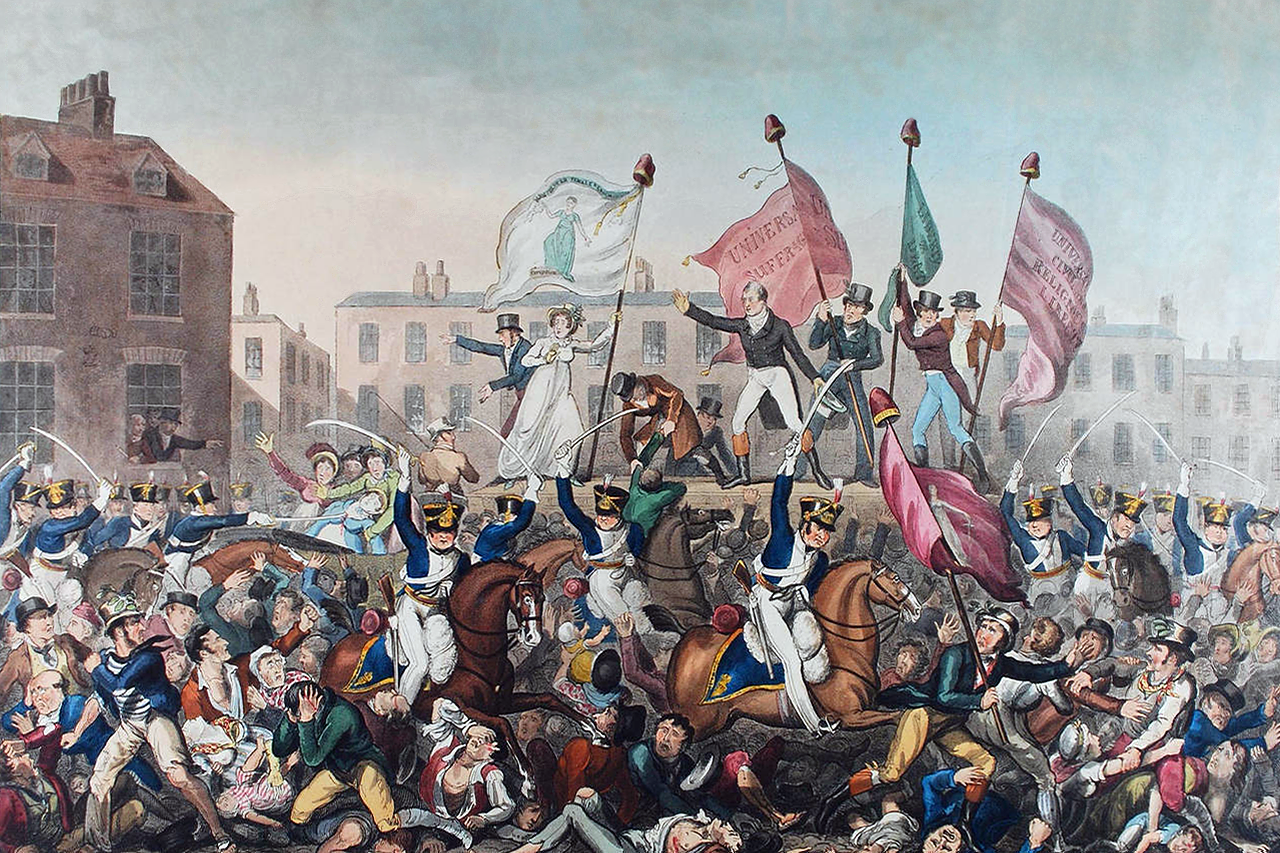
St Peter’s Field, Manchester, 16 August 1819. The woman in white standing on the cart is supporting universal suffrage

Emily Wilding Davison

Henria Williams

Mary Clarke

Thomas Aston

Richard Boothman

Emily Wilding Davison is the easiest to identify. She was the suffragette killed by the King’s horse at the Epsom Derby on 8 June 1913. Much has been written and hypothesised about Wilding, this incident, her return rail ticket and whether she was martyr or victim of tragic mistiming but whichever conclusion you take, Emily Davison died in the struggle for female enfranchisement.

The date for the demand for universal suffrage is debateable and in the early years of universal enfranchisement it essentially meant enfranchisement for men not women. It was certainly on the agenda by the early 1800s. Take the Peterloo Massacre for example. A huge open-air meeting was organised where orator and radical Henry Hunt was to speak at St Peter’s Field, Manchester on 16th August 1819 (I attended the 200th commemoration). His topics included causes such as the repeal of the corn laws and universal suffrage. Attending on the day and clearly seen wearing white at his side on the cart he used to address the crowds were a number of women who also supported universal suffrage – for men. That women could have the vote was, at this time, deviant. Statistics for the size of the crowd, many of whom had walked several miles to hear him speak from, for example, Rochdale, Ashton under Lyne and Stockport, range between 60,000 to 100,000. Fearing political turmoil, the magistrates turned the dragoons and militia on the peaceful rally and statistics for the victims range from 11-20 for those who died on site or a few days/weeks later from their injuries plus 400-700 other casualties many of whom kept their injuries secret in case their employers found they had been there and dismissed them. All because ‘common people’ dared to want a change in the way the government was run and their representation within it. By the 1860s, the concept that women should also be enfranchised began to gain momentum but in the early years, this was generally regarded with consternation or downright hostility.

Known today as the Great Reform Act, The Representation of the People Act was passed in 1832. This momentous Act of Parliament abolished the Rotten Boroughs – constituencies which had a very small electorate but one or two MPs. Electors were often bribed with enormous sums of money to vote for one man or another. The most infamous constituency was Old Sarum in Wiltshire which had 3 houses, 7 on the electoral roll, tens of thousands of sheep and 2 MPs.

On the other hand, Manchester in 1831 had a population of 700,000 and no MP.  Following the 1832 Reform Act, it was awarded two. Birmingham was another city which didn’t return an MP until 1832. Even though its population was just short of 147,000 in 1831 it was only awarded one MP in the Act.  The 1832 Reform Act may have created 67 new constituencies, disenfranchised 56 others and reduced 31 to one MP but it didn’t widen enfranchisement. The only permitted voters were male (women were specifically excluded) who owned land, tenant farmers, shopkeepers and renters of property worth over £10 a year.

This rankled with a lot of men and by the late 1830s, the Chartist Movement supporting more democracy and parliamentary reform became popular. The Charter, which gave the movement its name, demanded 6 points:

  1. A vote for every man over 21. Finally conceded under the 1918 Representation of the People Act; married women over 30 whose husband owned property also gained the vote. All women over 21 were enfranchised in 1928. Ironically, suffragette Emmeline Pankhurst died 28 June 1928 a few weeks before the law was passed. Suffragiste Millicent Fawcett, on the other hand, lived to see the day and was guest of honour at a breakfast held at London’s Cecil Hotel celebrating women’s equal enfranchisement.
  2. Secret Ballot (prior to this, those on the electoral register literally had to stand and be counted).  The Secret Ballot Act was passed in 1872 and the first election held under this ruling was the Pontefract by-election 15 August 1872. It did not go to plan – see
  3. No property qualification. Since 1711, a prospective MP had to own property worth at least £600. Several men who won seats were disqualified for not owning enough property eg Feargus O’Connor in 1835. The requirement was repealed in 1858.
  4. Payment of MPs. Obviously, poor candidates would not consider standing for parliament. And if they became an MP and lost their income, working men wouldn’t stand either. Payment for MPs was passed as recently as 1911 under Herbert Henry Asquith’s Liberal Government. They received £400 a year. Today, a UK back bencher earns £91,346 plus expenses to cover their office, the staff to run the office, London accommodation if they live elsewhere and travelling expenses between London and their constituency.
  5. Constituencies of equal size. Refer back to Old Sarum above! In 2023, the borders of our constituencies were changed again to make electoral numbers more equitable. We only need to look at population increase under decennial census records to see how fast the UK population has grown. In 1801, it was estimated at 8.9 million. By 1841 it was over 18 and a half million. By 1881 it was not far short of 30 million. There were 50 million in 1950 and over 67 million today. The first attempt at addressing constituency size was under the Redistribution of Seats Act, 1885.
  6. Annual Parliaments. This is the only point which has not come to fulfilment. The current rules are that a government must call a general election within five years of its coming to power.

This leads me back to the men’s names at the top of this article. Thomas Aston and Richard Boothman were Chartists and two of 100 transported to Van Dieman’s for demanding more governmental democracy. Thomas Ashton was 16 when arrested for demolishing a house in Birmingham and transported for ten years in 1839. Two years later, weaver Richard Boothman, was transported for life aged 21 for life for killing a policeman in Colne, Lancashire. He vehemently denied he was present at the riot but, even though eventually pardoned, he died in Tasmania in 1877. Both men heavily refuted all accusations and it could be argued they died because they supported enfranchisement. For more information on transported Chartists see Mark Crail’s excellent website. For Chartists transported to Australia hit this link. Try a general Australian site for transportees. An excellent resource for more information about the Chartists can be found at the Working Class Movement Library in Salford – see their page on Chartism.

Unlike the UK, Australian elections today are mandatory. If you’re eligible to vote, you’re fined $20 Australian for not voting. The first colonists were in Australia not by choice but because they were taken there against their will. The majority were unenfranchised in the UK so it seems pretty obvious to me that electoral freedom is seen less of a right in Australia but more of an obligation although this is not how Australians explain it. If we had had the same rule in the UK at the time of the EU referendum when only 72% of the electorate voted, would we have had the same result if it had been obligatory?

Back to the three names at the top of my quiz. I’ve already covered Emily Davison. The other two women are less well known but were also female suffragists. Former teacher, Henria Leech Williams (1867-2 January 1911) joined Pankhurst’s Women’s Social and Political Union (WSPU). She was arrested 29 June 1909 when a group of over 100 women attempted to enter the House of Commons. On 18 November 1910, she was amongst a group of women marching to the Houses of Parliament attacked so violently by police that it became known as Black Friday. Appalled onlookers, especially men, wrote to the newspapers about it. One of the most notorious newspaper photographs of that day was of a woman prostrate and unconscious on the pavement – later identified as Henria Williams. Her rescuer, Frank Whitty, complained to the press of her treatment at the hands of the law. While she was recovering, Henria documented her treatment at the hands of the police; it is sobering reading. Two months later she died from a sudden heart attack on New Year’s Day; a combination, it is thought, of an underlying health issue plus police conduct on Black Friday. Henria is mentioned in Jane Robinson’s excellent book ‘Heart and Minds, The Untold Story of the Great Pilgrimage and How Women Won the Vote,’ Doubleday, 2018.

Mary Jane Clarke was Emmeline Pankhurst’s younger sister and her death is also attributed to Black Friday. Two days after Mary’s release from a month’s sentence in Holloway Prison (in lieu of a £5 fine for smashing a window at Cannon Road Police Station) Mary died suddenly on Christmas Day 1910 at her brother’s house in Winchmore Hill, London. Although her funeral was held in New Southgate, London, a wreath was hung on her front door in Brighton.

One person I mustn’t forget in this short history of enfranchisement is the allegedly first woman to vote in a UK parliamentary election. The Representation of the People Act, 1867, awarded the vote to all men over 21 who fulfilled the property requirement of either owning property or paying rental of £10 or more a year for their accommodation. This immediately increased the electorate from one million men to two million men out of a total 1861 UK population of just over 23 million. Before you say your ancestors were too poor, cordwainer John Emm (not my direct ancestor) lived in Minerva Street in Whitechapel and appears on the 1867 electoral register (see Ancestry and FindmyPast; both subscription). Although his sons were over 21, they don’t because they didn’t pay the rates.

Several women’s names fell between the cracks because they were property owners and their names appeared on the electoral register by mistake. Amongst them was Lilly Maxwell (born c1800), a shop owner in Chorlton cum Medlock, Manchester, whose name appeared on the electoral register two days before the November by-election. Aided, abetted and encouraged by suffragist Lydia Becker (1827-1890; see Joanna M Williams biography, The Great Miss Lydia Becker, Pen and Sword, 2022) and Richard Pankhurst (he married Emmeline nee Goulden in 1879), Lilly Maxwell voted in the 1867 by-election for Liberal and female suffragist Jacob Bright. Remember, this was before secret ballot so Lilly Maxwell had to vote in person braving the men also stating their preference and presumably facing considerable disapprobation and jeers. Bright won.

A general election was called the following year and Becker plus several other female suffragists encouraged all rate-paying women to apply to be included in the electoral register under the guise that ‘man’ was a generic term for ‘person’ ie included women. Thousands applied but the government slipped in a proviso; their application must be approved by a male barrister. Remember there were no female lawyers at this time. Country-wide only two barristers, one in Manchester and the other in Oldham endorsed a few women’s application. Stymied, a mere 13 women had their applications approved for Manchester’s electoral register but only nine, supported by Lydia Becker, had the courage to vote. The following year, the Act was specifically amended to disallow women voting.

However, there were a few chinks of light – local government. In 1869, the Municipal Franchise Act permitted women rate-payers (ie property owners or paying rent over a certain amount) to vote in municipal (local) elections. Effectively, only spinsters and widows had the vote because at this time a woman relinquished all money and possessions to her husband on her wedding day. Women could not, however, stand for election.

From 1875, women were eligible to stand as Poor Law Guardians responsible for conditions and finances within the much-feared workhouse. Some eminent women took on this role including Emmeline Pankhurst (later appointed Births and Deaths Registrar for Chorlton-cum-Medlock, Manchester and recorded as such in the 1901 census) with her daughter Christobel later helping her as assistant. Margaret Baines, daughter of the owner of the Leeds Mercury, was another Poor Law Guardian as was Louisa Twining of the eponymous tea firm.

Being appointed to school boards under the 1870 Education Act was another method by which women claimed public office. Lydia Becker proudly cited it on her 1881 census occupation record. Activist Annie Besant, educationalist Emily Davies and first UK female doctor Elizabeth Garrett Anderson (suffragist Millicent Fawcett’s sister) were all on school boards. London’s Guildhall Art Gallery has a wonderful painting by John Whitehead Walton depicting the London Education Board ,1873. The painting is awash with male faces but two women, Emily Davies and Elizabeth Garrett Anderson, can be glimpsed tucked in amongst them. Incidentally, in Aldeburgh, Suffolk, 1908 on the death of her husband Elizabeth Garrett Anderson was the UKs first appointed female mayor.

I’ve already mentioned the 1867 Representation of the People Act which awarded the vote to all rate-paying men over the age of 21. By 1900, astute middle-class families had worked out how to enfranchise their live-at-home unmarried sons. By charging rent for rooms in the family home! The 1905 Stockport ‘Lodgers’ List. Parliamentary and Parochial Electors’ is chock-a-block with single young men in upmarket suburbs paying rent to their fathers for sole use of bedroom and joint use of sitting room furnished. The young men paid varying amounts of rent to the ‘Landlord’  was named in the registers final column. Frank Sutcliffe Ireland paid his dad William Ireland of the same address, 151 Manchester Road Heaton Norris, 7s a week. A few doors down the road, Stanley Jackson paid his mum, Emma, 10 bob a week for similar accommodation. Thus these canny young men exceeded the annual rent for eligibility on the electoral roll.

In 1918 universal suffrage was granted to all men over 18 and married women whose husbands were ratepayers. This ensured peculiar anomalies such as in ahouse in my road in 1919 where mum could vote but her married daughter living with her husband in the same property did not appear on the electoral register although her husband did. Her two brothers, still unreturned from war service, were on the absent voters list.

In 1928, all women over 21 were enfranchised. The voting age was lowered in 1969 to 18 for everyone. Various factions today are arguing for it to be lowered to 16.

I taught in a further education college for a while and often faced political and electoral apathy from students. I remember saying to one female student why her vote was important – why every vote is important and that if you don’t vote, you have no right to complain. In many parts of the world, many are making great sacrifices to gain a right to change their government and in many parts of the world this right is still denied. Yet the UK 2024 election achieved the lowest turnout ever  – only 52% of the registered electorate cast their vote – the lowest since we gained universal suffrage. Emily Wilding Davison, Henria Williams, Mary Clarke, Thomas Aston and Richard Boothman will be turning in their graves.

What links the Rokeby Venus, Pinkerton’s Detective Agency, the Duchess of Devonshire and my house?

Ans; Thomas Agnew and Sons, art dealers

Georgiana, Duchess of Devonshire (as played by Keira Knightly in the 2008 film The Duchess) was painted by Thomas Gainsborough (1727-1788) between 1785 and 1787. Having been lost from Chatsworth House for some time, in 1841 a former schoolmistress sold the Duchess’s picture to a private dealer for £56 – not a bad price when live-in housemaids on a country estate earned a mere £10 a year. In 1876, after the death of a subsequent owner, the Gainsborough painting resurfaced at London auction house, Christie’s, and the hammer went down on the princely sum of 10,000 guineas (£10,500). The buyer was William Agnew of Thomas Agnew and Sons. Three weeks later, the very same painting was stolen from their vaults and for the next 25 years nothing was heard of the most expensive painting ever to have been bought at auction.

On the 10th March 1914, suffragette Mary Richardson slashed Velázquez’ Rokeby Venus at London’s National Gallery with a meat cleaver. Her justification? She wanted the government to release fellow suffragette Emmeline Pankhurst from prison and, as the painting was amongst the most well-known in the gallery, she targeted it. The Rokeby Venus was famous because, having been bought from the Rokeby Estate in Yorkshire (hence the name), it was put up for sale in 1903 by art dealers Thomas Agnew and Sons for the enormous sum of £40,000. As the National Gallery Art Collection had just been set up by the British Government, the very first painting purchased for the nation was – yes – the Rokeby Venus.

So why am I whittering on about a London art dealer? What on earth has it to do with my house?

During lockdown, for want of anything better to do during long empty days of isolation, I researched the residents of my 16-house road built in 1904. Between 1914 and approximately 1925, a family named Smith lived here. When a family historian encounters the surname Smith, their heart sinks; it’s the most common surname in the English-speaking world and notoriously difficult to research. Add Thomas, John or William to the mix and you’re travelling the road to nowhere – they are amongst the top 10 names ever!

However, I found Thomas in the 1911 census visiting his widowed mother and siblings whilst wife Jessie showed off their firstborn son to relatives in Southport. He was a salesman in ‘fine art.’ Now call me a cynic but I imagined him working in a small, seedy picture framing workshop or flogging stale watercolours in some Manchester side street. Nothing fancy…

On the 6th January 2022, to much fanfare Findmypast published the long awaited 1921 census online. I duly trooped down to Manchester Central Library, one of three centres where the census can be accessed for free. The other two are the National Library of Wales and The National Archives in Kew, London. My objective; to clear up anomalies and queries hanging over some residents of my road. The unique selling point of the 1921 census is that it not only lists a person’s occupation but it also names their employer and address. My Thomas Smith managed the Manchester branch of Thomas Agnew & Sons, art dealer. The showroom was 14 Exchange Street, Manchester, the poshest area of Manchester City centre.

And I had never heard of it.

A Google search later and I was screaming at my laptop. Thomas Agnew & Sons has a Wikipedia entry; its own page on the National Gallery’s website and is listed in Grace’s Guide. After new ownership and rebranding, it’s still in existence as the Agnews Gallery. Not to be confused with auction houses like Christie’s, Sotherby’s and Bonham’s, it was (still is?) the most famous art dealer in the world. And a resident of my house ran the Manchester branch from c1914 until the stockmarket crash of 1932 when the Manchester branch closed. (I must look for a Velázquez’ and Gainsborough in the attic.)

Thomas Agnew and Sons was born in Manchester as an 1817 partnership between Italian print-seller and framer Vittore Zanetti and Thomas Agnew (1794-1871). In 1834, Agnew became the sole proprietor, his sons joining the enterprise in 1851. Their prosperous business moved into purpose-built headquarters in 1877 at 42-43 Bond Street, Mayfair, one of London’s most famous and prestigious streets. In its heyday, Agnew and Sons had branches in Liverpool, Manchester, Paris, Berlin and New York. Its archives were held by the company until sold to the National Gallery in 2013.

What exactly did my Thomas Smith do in the gallery each day? Regional newspapers give us a clue. For instance, they advertised upcoming sales. Under his tenure, I discovered the following newspaper announcements;-

Burnley News, 28 April 1923 Page 9 

NEW PURCHASES The following watercolour paintings have just been purchased out of the funds allocated to the Art Gallery Committee from the Edward Stocks Massey Bequest:— “Kits Flying,” by Charles Harrington, and ” Fruit,” Wm. Hunt, from Mr. H. Bateman, of Manchester; Landscape by Copley Fielding, and Seascape (P. de Whit, from Mr. C. A. Jackson, Manchester; “Coblenz,” J. B. Pyne, and “An Arab Girl,” by E. Lundgren, from Messrs. Thomas Agnew Sons, Manchester. According to Lord Leverhulme: “There was never picture bought but there would relief to the rates.” shall look for a substantial reduction next year.

And another advert in Yorkshire Post and Leeds Intelligencer, 21 November 1925 P1 

EXCHANGE STREET GALLERIES.

EXHIBITION OF SELECTED

WATER COLOUR DRAWINGS.

THOS AGNEW and SONS. 

14 EXCHANGE STREET. MANCHESTER.

The Manchester branch was a satellite dealing in watercolours rather than old masters. I guess when Thomas found something exceptional in his travels around the North West, he despatched it to Bond Street where it would achieve a higher price than in the provinces.  

Findmypast also names employees; Agnew’s Manchester branch employed at least 14 men although some were based at Salfrord’s Worsley Street works including French polisher Wycliffe Ross, gilder Thomas Gormley and mount cutter William Booth Whinfield.

I can’t end this blog without revealing what happened to the Gainsborough painting stolen from Thomas Agnew’s vaults in 1876. I can assure you Georgiana is not in this house with me more’s the pity!  

Enter the shadowy world of Pinkertons, the most famous private detective agency in the world founded in the USA in the 1850s by Scotsman Allan Pinkerton.

Twenty-five years after the initial theft, it was discovered the thief was the notorious arch-criminal Adam Worth (1844-1902), the ‘Napoleon of Crime’ reworked and revisualised by Arthur Conan Doyle in his Sherlock Holmes books.

Worth had stolen Gainsborough’s The Duchess to bail out his brother from prison but when his brother was unexpectedly released, Worth no longer required the money. Instead, he kept the portrait for himself. Legend has it he was so enamoured of The Duchess that he slept with her next to his head. Towards the end of his life in 1901, Worth approached Pinkerton’s Agency demanding $25,000 for her safe return to Agnew’s. Portrait and payment exchange took place in Chicago after which the painting was returned to London and put up for sale. She remained in private hands until 1994 when she was sent for auction at Sotheby’s. She has finally returned home to the Chatsworth Estate. Meanwhile, perhaps I can knock on the door of the house where the Smith family moved circa 1926 and ask if they found any paintings in their attic. Dream on…

Ten Things you Didn’t Know About Stockport – or perhaps you do…

In no particular order…

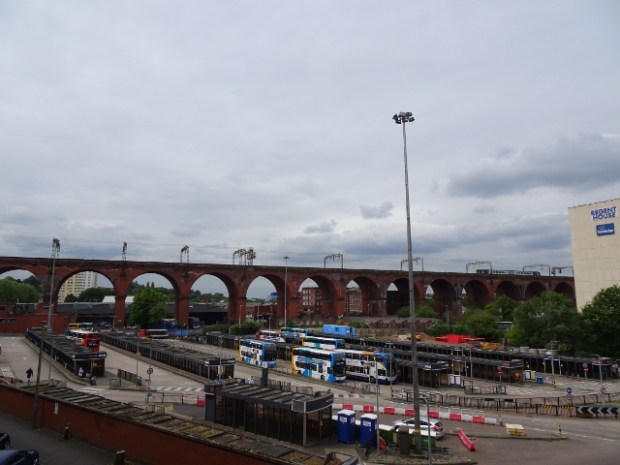
Stockport Viaduct. The River Mersey’s banks are to the right where the trees are

1. Stockport per se is not in the 1086 Domesday Book compiled after the 1066 Norman invasion. However, nearby Bramhall (Bramale), held as two manors owned by freemen Brun and Hakun, was described as ‘a waste’ which is pretty ironic when Bramhall today is one of the most sought after residential areas in the borough. Bredbury (Bretberie in 1086) was owned by Richard de Vernon, a common name in Stockport including Vernon Park, Vernon Building Society, Vernon Primary School and Vernon Mill. Originally a cotton spinning mill, Vernon Mill is now under multi-business occupaption. Werneth (Warnet), Romiley (Rumelie), Cheadle (Cedde) and Norbury (Nordberie) also get brief mentions in the Domesday Book.

2. The River Mersey formed the ancient boundary between the Anglo Saxon kingdoms of Mercia and Northumbria. It starts in Stockport town centre with the confluence of the Rivers Goyt and Tame and flows from here to Liverpool and the sea. Its name, first recorded in 1002 during King Ethelred’s reign as Mærse, literally means ‘river border’ and became the county border between Lancashire and Cheshire. Lancashire Hill was thus named because it’s on the Lancashire side of the river. Today, the Mersey runs beneath the 1960s-built shopping precinct, Mersey Way, revealed at one end of the pedestrianised section and at the ‘Bullring’ by Stockport Plaza cinema/theatre at the other. An anomaly today is that the part of Stockport to the Manchester border, even though it’s the ‘wrong’ ie Lancashire side of the river, is in Cheshire.

The River Mersey emerging at ‘the bullring’ from the tunnel under Mersey Way
Lancashire Bridge blue plaque on Stockport’s town centre bridge over the River Mersey

3. Although primarily remembered as a former hat (from the 1650s) and cotton town, Stockport was the site of England’s third silk spinning mill.  Built in 1732 on ‘the park’ on the bank of the River Goyt just before it merged with the Tame (point 2), Logwood Mill (later Park Mill) was set up by Italian-born John Guardivaglio aka Nathaniel Gartrevalli (imagine living in 1730s Stockport when no-one went abroad and never met anyone from Italy and repeat ‘Giovanni Guardivaglio‘ and ‘Nathaniel Gartrevalli‘ with an Italian/Manchester accent) who was given the dosh by six entrepreneurs. A noticeboard and map on Warren Street shows where Park Mill stood. John Gardivaglio arrived in England with industrial spy John Lombe (1793-1822) who, circa 1716, stole an extremely secret Italian process of spinning warp thread (organzine) from silk cocoons and the two fled Italy for their lives. John Guardivaglio remained in Stockport, marrying here at the old St Mary’s Parish Church, and was buried here (as a pauper) in 1788.  When silk spinning became economically unviable, Stockport span cotton. Its last hat factory closed in 1997.

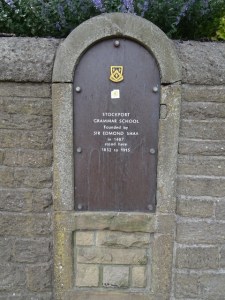
Stockport Grammar School from 1832-1915 site plaque. on the wall beneath Stockport’s War Memorial
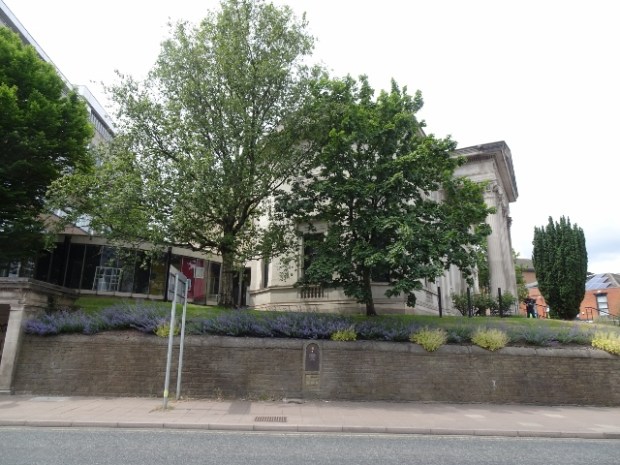
The former site of Stockport Grammar School on the corner of Greek St and the A6 from 1832 until its demolition during WW1. Stockport’s Art Gallery War Memorial stands there now

4. The second oldest school in the north of England, Stockport Grammar now sited in Davenport, was founded in 1487 by goldsmith and merchant Edmund Shaa. His legacy paid the wages of a priest to teach Latin and Greek grammar to local boys for free. In 1496, its teacher, John Randall, was paid £10.  The first lessons are believed to have been taught in St Mary’s Parish Church and from 1608, the school stood in Chestergate on land which is now the 1960s precinct. It remained here for over 200 years until relocating to Greek Street. In 1915, during World War I, it moved to its current location in Buston Road. Stockport’s Art Gallery War Memorial now stands on the site.   In 1482, Edmund Shaa was Lord Mayor of London and appears as such (although not named) in Shakespeare’s  Richard III.  Why? Because Edmund Shaa was involved in Richard of Gloucester’s usurpation of the throne when he became Richard III. There’s also a Shaa Road built in the 1880s on land owned by the Goldsmith’s Company in Acton, West London. A history of Stockport Grammar School can be found via this link.

5. The iconic viaduct built for the Manchester and Birmingham Railway Company (London & North Western Railway from 1846) was completed 40 December 1840 and the world’s largest viaduct at that time. Today, it’s still one of the world’s largest brick built edifices. Containing 22 arches 63 feet high (19.2m) built from about 11 million bricks, it took more than 600 men 21 months to build and was widened in 1887-1889 with a further 11 million bricks. The entrepreneurs behind the construction insisted all trains from Manchester, a mere ten or so minutes down the line, must stop at Stockport station hence why most still do today. The viaduct features in several L S Lowry paintings. The view of distant hills and Stockport below from the train crossing the viaduct is magnificent. 

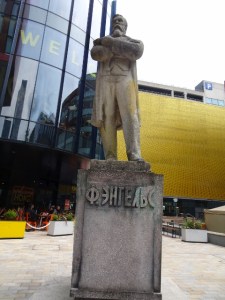
6. If Trip Advisor existed when Friedrich Engels (1820-1895) was researching and writing his 1845 seminal work The Condition of the Working Class in England, Stockport would have received an appalling review. The above viaduct is also included in his commentary. Engels described Stockport as ‘one of the duskiest, smokiest holes, and looks, indeed, especially when viewed from the viaduct, excessively repellent. But far more repulsive are the cottages and cellar dwellings of the working-class, which stretch in long rows through all parts of the town from the valley bottom to the crest of the hill. I do not remember to have seen so many cellars used as dwellings in any other town of this district.’ 

Friedrich Engels’ statue in First Street, Manchester. Engels wrote ‘The Condition of the Working Class in England’ whilst living in Manchester. He didn’t like Stockport

Thankfully, Stockport is more pleasant today and has some wonderful places to visit!


Stockport Grammar plaque on wall below Stockport’s Art Gallery War Memorial

Census 2021 – 220 years of number crunching

How do we know agricultural labourers formed the biggest employment group in 1841? Or that 1,038,791 people earned their living as servants in1851? Or if there are more women than men?  Why, a census of course. And 2021, is census year.

From the late eighteenth century, the industrial revolution was gobbling up the countryside and it felt like there were more people than ever – but unless you perform some sort of exercise to prove it, some type of head count, there’s no evidence to back up perception.

England and Wales have ‘counted’ their population every decade since 1801. For the three censuses between 1801-1831 only 791 listings (at parish level) have survived usually naming only the householder.

I love looking at old censuses. The 1841 is quirky. No relationships are recorded for the household so anyone in the same house could be related – or not. Ages are given; but for those over 15, they’re rounded to the nearest 5 years and, although the rule was to round down, the enumerator didn’t always follow instructions. Enumerators had to be literate but, of course, the majority of the working class in 1841 weren’t and, because the main householder was supposed to complete their own form, you can imagine issues resulting from illiteracy. Handwriting was appalling and numbers badly formed. Once the schedules were completed, they were collected by the enumerator and copied into handbooks. These are the documents we find online. Now consider the enumerator who couldn’t read the writing or the numbers. He did as accurate a job as he could but there are often mistakes. I’ve seen ‘Emm’ transcribed all number of things like Evans, Emms, Im or Emin and no, I’m not related to artist Tracey.

People were often recorded with a pet name so baby of the family could be ‘Billy’ not William and it was common to name children after their parents. A hypothetical example: let’s call both mum and daughter Elizabeth Jane. In the census, mum  might be ‘Betty’ and daughter ‘Jenny!’ This confuses an awful lot of family historians until they realise shouting ‘Bert’ in a household with Albert senior and Albert junior and another son called Herbert put everyone in a tizzy.

Census day was usually held in March or April (it’s Sunday 21st March in 2021) and the census counted everyone staying overnight at an address. This is why you find ‘visitor’ in some households;  often relatives – mum staying with son and daughter-in-law, or grandma visiting a new grandchild. 

Desperately poor families might rent out a room, cellar or attic to another family for extra income. These might be recorded as lodgers or enumerated in the same building as a separate household. What did this tell statisticians? The area was poor with a high density of population.

Where people originated from was another statistic extracted from the census. Twenty five per cent of Lancashire’s population in 1861 was from outside the county. Economic migration in process… The Irish were crossing the sea to Liverpool for employment. The railway network was expanding and people followed the railways from the south to the north or north to the south. Not only could agricultural workers leave the countryside to seek more profitable work elsewhere but they might even (often did) work for the railway companies.  As technology progressed, machinery replaced manual labour and the workforce deviated towards a different industry.  A 20th century example is the replacement of male clerks with female secretaries and huge typing pools full of women. Computerisation in the 21st century resulted in a proliferation of people working in IT. Where are those secretaries now?  Remember carbon paper?

The paper census of yesterday is largely digitised in 2021 but the trend of where we live, how we earn a crust and how long we live is as important as ever.

Of course, for family historians out there, we use the census for a completely different reason. Snooping on the progress of our family; how they loved, where they lived and how they improved their economic standing  – or not. The ups and downs throughout the centuries.

Can you remember what you were doing and where you were living in 2011 and 2001? Next year, 2022, the 1921 census will be released initially on FindMyPast (subscription). The 2021 census will be released to nosey parkers like you and me in 2121 so if anyone recently born reaches their centenary, they can see themselves in the palimpsest of history. 

For more information on the history of the census and what information was gathered over the years, see The National Archives and Family Search. And, if you are in England and the UK, relish in completing that form!


Tragic death and restitution in Stockport

Willow Grove Cemetery  is about a mile from where I live.  I don’t know about you, but I appreciate the serenity and peace of graveyards; their silence, the trees, flowers, birds and squirrels but, above all, long forgotten stories and personal tragedies.

The sign in Willow Grove Cemetery.

Willow Grove is punctuated by notice boards recounting histories of some residents. James Gaskell caught my eye. In a nutshell, the sign tells us James Gaskell, aged 37, died 11 October 1906 pushing a seven year old girl out of the way of an electric tram in Great Portwood Street, Stockport.   Erected by public subscription, the gravestone is ‘in admiration of the act of heroism.’

I spotted a discrepancy on  the gravestone itself.  He died, not in October but April 1906.  Inscribed at the bottom obscured by grass and pink clover was the name of his wife, Emily Jane Gaskell, buried alongside him.

James Gaskell gravestone

Not just because of the fundamental error on the noticeboard but in consideration of such a tragic yet ultimately heart-warming story, I had to investigate further.   

Did James and Emily have children?  What happened to them?  What about the little girl he saved?  What happened to her?  In effect, what happened next?

Bearing in mind reporters in the past made factual mistakes (not always their fault; illiterate people can’t spell their names and people often didn’t know how old they were), I turned to the BNA.

James Gaskell’s inquest was held on the 16th April 1906.   James was a hatter with wife and two children and the child he saved was ‘a little boy named Barrett.’  So much for the seven year old girl!

I started with hero James Gaskell.  In 1891, he was an apprentice hatter living with his parents (dad was a blacksmith striker) and six siblings at 179 Brinnington Rise (now Brinnington Rd) an extension of Great Portwood Street where James ultimately met his death.   His siblings worked in the cotton mills. Two years later James  married Bangalore-born Emily Jane Thompson and by 1901 James, Emily, their sons, 6 year old James and 3 year old Charles Edward, were living with granddad James Gaskell senior at 33 Hill Street, Portwood, Stockport.  Walking from home to Great Portland Street by passing their parish church, St Paul, would have taken about three minutes. 

Hill Street and the neighbouring streets no longer exist.   The Peel shopping centre now stands where once they did.  Portwood was (partly still is) an area of heavy industry; tanneries, bleach works, gas works, and mills sharing the banks of Rivers Tame and Goyt which, a little further on merge into the River Mersey eventually reaching the coast at Liverpool.   An 1899 map showing Great Portwood and Hill Streets is found at  https://maps.nls.uk/view/101598010

Who was the little boy Barrett James saved from a tram car? 

The surnameBarrett/Barratt is relatively common and in the 1901 census there were two boys of relevant age living in James’ road.    10 month old William Barratt was the son of a spindle maker and he and his family lived at No 28.  Born around June 1900, he was 5 or 6 at the time of the accident so I discounted him.     

In Howard Street, the other side of Great Portwood Street, was another contender.  However, Thomas Barratt was a policeman’s son and I think that would have been mentioned at the inquest and in newspapers.

However living at No 1 Hill Street was greengrocer Henry Barratt and wife Ellen.  Their son Fred was baptised  17 October 1898 making him  7½ in April 1906. 

James’ heroic action is now personal!   Not only did he spot the danger to a child but in a split second realised he knew the boy…  the greengrocer’s son at the end of his road!  And in a split second, James shoved a neighbour’s child out of the way of imminent death – and was killed himself.

What happened to the boy whose life was saved?    In 1911, the greengrocer’s family now swelled to three sons ranging in age from schoolboy Fred, 12, to baby Sidney, 2, had moved to 39 River Street; five people in three rooms.   Fred’s dad still ran his greengrocer’s shop so if it were here, the family were shoehorned upstairs.   Fred next surfaces in the 1939 Register as a paper storesman and Works’ Air Raid Warden/first aider thus repaying James’ gift of life.  Sharing his home in Jennings St., Edgeley, was wife Martha and daughter Vera.  Fred died at home 30 October 1943 having easily repaid James Gaskell’s sacrifice.

James’ two sons?     The subscription for their father’s heroism raised £381 including a donation of 5 guineas (£5 5s= £5.25 today) from James’ employers.   This was a lot of money at a time when £400 would buy a small house however in 1911, Emily Jane, her two sons and their grandad, James Snr, lived at the same address, 33 Hill St.  I can find no WW1 records for elder son James although he was 20 when the war began. He married Gladys Preston in 1928 and in 1939  the couple were at 79 Winifred  Rd., Davenport, where  James was employed as a heavy worker at the gas works.   Like Fred Barratt whose life was saved by James’ dad, he too was an ARP Warden.  James died, aged 80, in 1974.    

Younger brother Private Charles Edward, 8 when his father was killed, survived WW1 (Cheshire Regiment; discharged November 1919 back to 33 Hill St) and married Mary Watson in 1931.  He became a finance clerk for the local education authority and in 1939, the couple lived at 7 Arlington Drive, Woodsmoor (just over a mile from his brother) with her parents, retired butcher Fred, and Elizabeth.   Did Charles realise his father-in-law had the same name as the child James Gaskell had saved? 

James’ widow Emily Jane never left 33 Hill Street.  She was there in 1939.  It was her address when she died at St Thomas’ Hospital 10 November 1957. Charles inherited her estate of £645 – £200+  more than the subscription raised for her selfless husband.    When Emily Jane was reunited with her husband, she’d lived with his ghost in the same house for over 56 years. 

There’s no plaque to James Gaskell in London’s Postman’s Park which commemorates 62 people who sacrificed their lives saving others.   Perhaps there should be.

Willow Grove Cemetery showing the notice board and, two rows behind, James Gaskell’s gravestone

Bigamy bigamy – so good he married twice

For those of you in the UK, I hope you’re enjoying David Olusoga’s third BBC series A House through Time based on a Georgian house in Bristol.  In a recent episode, a programme ‘character’ was a shadowy guy who, in the late 1790s/early 1800s married a resident’s daughter by licence.   This chap was already married and his first wife was still alive…

Now I love this programme but content decisions are made due to time constraints and this episode omitted some really important and interesting points about marriage licences and bigamy so here goes…

Olusoga’s programme pointed out a £1,000 penalty for lying about ‘impediments’ on a marriage licence and explained it was to dissuade someone from committing bigamy.  £1,000 is a stiff fine today but at the turn of the 18/19th century was the equivalent of  over £83,000. Some disincentive! The programme glossed over the fact marrying by licence was quicker.  It was also more discrete!

The majority of couples married by banns.  This required the church minister to declare their names in the Sunday service for three consecutive weeks.  It gave a chance for someone in the congregation to speak out should they know one of the prospective couple was already married.  A current spouse is the ‘impediment’ in the phrase ‘does anyone know of an impediment?   Although we know it’s a formality to ask the question, everyone today still holds their breath for a fraction of a second.  What if…?

As a result of the nineteenth century population explosion, it was common in the 1840s, 50s and 60s for up to thirty (and more) couples to be married in the same church at the same time.  So many babies were born, mass baptisms were expedited.    

If you were prominent in a community; the lawyer, the family doctor, local squire, did you want to be married alongside a road sweeper, agricultural labour and spinner?  Of course not.  So you married by licence and paid more for the privacy it afforded.  As a bonus, your names weren’t prattled in front of the hoi palloi every Sunday for three consecutive weeks.   Nine months later, the baby was baptised privately…

Back to our house in Bristol and the bigamy element.  Until the Matrimonial Causes Act, 1857, divorce was impossible!   It required an individual Act of Parliament, a humungous amount of money and only 300 divorces in total were realised before this date.    

The penalty for bigamy at the beginning of the nineteenth century was more than severe.  A bigamist could be executed!        Yes, it was a capital felony until 1 July 1828.    The marriage licence penalty of £1,000 was well worth the risk.

Even into the twentieth century, a bigamous husband (it was usually the man) was fined and/or sent to prison for six months.

You can read more in my book Tracing your Female Ancestors.

Medieval trading practices – 2020!

When the world goes wrong, we revert to basics… no more self-service. Back to counter service only. I remember greengrocers beautifully displaying their wares, shiny apples to the front, perfect lettuces, radishes and potatoes to the back.  Touch them – you received a metaphorical slapped wrist.

Blaggs Hardware shop serving from their counter

Blaggs in Heaton Moor Road has been trading as a hardware and ironmongers’ shop for over a century.  In their house (built 1904), my next door neighbours have an original servant’s bell system supplied by this very company.

However, corona virus has resulted  in Blaggs changing their service to medieval trading practices – with a twentieth first century twist. Instead of entering the shop, a customer waited outside.  

Flashback more than half a millennium to the middle ages – this is what traders did then.  Instead of a counter, they dropped their window shutter into the street and, supported by ropes, their shutter transformed into a counter.  Wares were displayed on this or a table inside their workroom visible from the street.  In some parts of the world, Vietnam for instance,  it’s still often very similar.

The modern twist at Blaggs?  No cash or coins – only contactless!

Sadly, as I write this, Blaggs closed their doors to personal customers but are delivering to local customers.    Flashback again to when they first opened in the early Edwardian age. Then, they employed a delivery boy with hand cart or, if he were very lucky, a bicycle.

Treading the boards, an actor’s life, 1911

111 Wellington Road North, Stockport, today is a car showroom but 100 years ago, a seven-roomed theatrical boarding house stood on this site.  With regular trams puttering between between Stockport and Manchester city centre, it was a convenient bed-stop for strolling players and theatrical vagabonds.

On census night, 2nd April 1911, 25 year old Doane Gardiner was lodging in two rooms at this address where London-born Clara Hayes ran her theatrical digs business. His entry reads ‘actor, Shakespearean Repertoire, legitimate stage.’  This is a long way from his home as he intriguingly gives an address of c/o Morgan Grenfell & Co, London EC (his bank) and place of birth as Albany, New York. So what on earth was this chap doing in Stockport?  A romantic version of the wild west?

Doane’s description of himself was very specific. What was repertoire and legitimate theatre? Even in the theatre, the class system ruled.  Doane was a Bishop’s grandson, so there was no way he would have performed in risque music hall. No, Doane was a serious thespian hence his care in the census records. Repertoire was an established theatrical tradition; actors performed a production six nights a week plus two matinees whilst rehearsing their next production. They might even perform several different plays in one week. In 1911, there were not paid for rehearsals soit was a hard graft indeed. Anyone with theatrical aspirations took the menial position of assistant stage manager supporting the stage manager with props, sound effects, and rehearsals – whilst taking on smaller roles as cast all whilst learning on the job. Meanwhile, many theatrical troupes travelled round the country from venue to venue – a week here, a week there, travelling by train and staying in digs which they paid for out of their salary. Tough.

So why was an actor from New York performing in Stockport of all places?  A quick scan of the 31st March 1911 edition of the Stockport Advertiser reveals an advertisement for The Theatre Royal Stockport (long since demolished) in St Peter’s Square three or four tram stops from Doane’s digs.   The theatrical offering for discerning Stopfordians that week was a different Shakespeare play each night, a choice including Romeo and Juliet, Twelfth Night, Othello, Taming of the Shrew and As You Like It. There was more of the same the following week. Doane was not headlining.

A year earlier, in the US 1910 census, Doane is found, an actor, living with his parents in New York.  His sister Margaret, by the way, became a suffragist. To discover what our potential leading man looked like, his application  for a US passport  in June 1906 revealed a student at Harvard University; 5ft 10” tall (taller than the average Englishman), a small mouth, prominent chin, high forehead, brown hair, grey blue eyes, roman nose and oval face. Hamlet anyone?  He intended to return to the USA within five months.

As an American citizen, he was under no obligation to fight for the British Army when we went to war against Germany in 1914. However on the 30 November, just three months after England had declared war, he became a naturalised British Citizen. His occupation? Actor and stage manager. The US Adjutant General Military Records testify what happened next.

‘Enlisted private Machine Gun Corps, British Army 1914; transferred to Inns of Court Officers’ Training Corps; promoted corporal January 1915; commissioned 2d lieutenant 3rd Reserve Battalion, City of London Royal Fusiliers in April; served as officer in charge of Zeppelin observation posts; commission lieutenant January 1916; went to France in November; organisation attached to British 4th Army; transferred to supply service; with Army of Occupation, Germany; returned to England and demobilized February 1919.  Engagements: Flanders 1916 and 1917. Twice mentioned in despatches.’

What a hero!


Divorce 1900 style

My cousin got divorced in the 1940s.  It took her years to live down the shame.  I never understood why a woman felt humiliated by chucking in an abusive partner who beat her up – or why neighbours gossiped behind their hands about this ‘scarlet woman.’  He, on the other hand, was regarded as just one of the lads…   Imagine, therefore, how a woman was treated in the 1890s! 

Before 1857, just over 300 marriages ended in divorce.  Let me rephrase that.  Before 1857, for a married person to wed someone else, he (it was inevitably the husband) had to obtain a Private Act of Parliament. Only the exceedingly wealthy could afford one and the only permissible justification for divorce was adultery.  Because it was an individual Act of Parliament, the paperwork for 314 divorces is stored in the archives at the Houses of Parliament…  

As for everyone else… they didn’t bother.   

Following legislation in 1857, it became slightly easier but still expensive.  And, because divorce courts were only tried in London and, because the background to a divorce was generally juicy, divorce hearings and their sordid details were published in local and national newspapers. News of the screws indeed.

This is the backdrop to a story I discovered about Scottish-born Ellen Frances Addie who’d grown up in an affluent area of Stockport; Heaton Moor.  On the 16th November 1892, 22 year old Ellen married Frederick Pickard, also 22, at the local congregational church.  For a short while they were in Douglas on the Isle of Man before returning to Heaton Moor to live with her parents in Lea Road.  They’d been married less than a year.  As Ellen was already pregnant, perhaps she wanted the support of her mum; she certainly wasn’t getting it from Frederick.

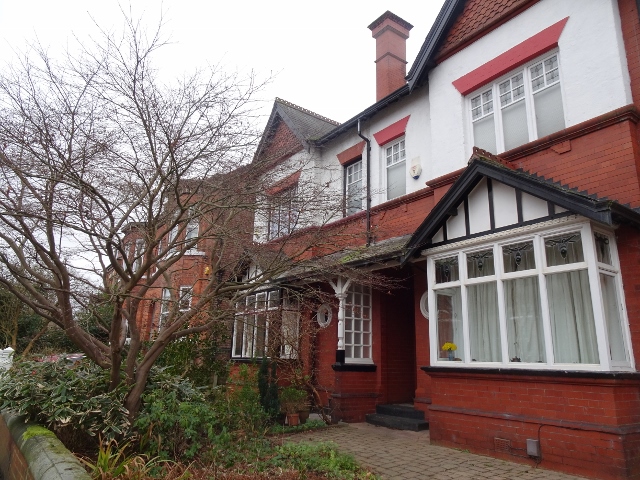
Lea Road, Heaton Moor, Stockport.
© Adèle Emm 
Lea Road, Heaton Moor, Stockport
© Adèle Emm   

It gets worse.  As I read the petition (Ancestry, subscription), my jaw dropped lower and lower and the ‘Oh my Gods!’ grew louder and louder.  Today, we might laugh.  To a late Victorian this was… well… indescribably shocking. 

Ellen’s divorce petition (24th April 1900) explains what happened next.  On 1st November 1893 Frederick ‘has since lived separate and apart from her and discarded her without reasonable excuse.’   Less than a month after leaving his wife, their daughter Marie is born.  Callous brute.

Not only had Frederick deserted her but, on the 25th April 1898 under the assumed name of Frederick Cecil Gill he ‘married’ Catherine Phelan at St Joseph’s Church, New York, USA.  Bigamously! By November 1898, Catherine Phelan, too, had given birth. A son. Did she know Fred was already married?  Did she care? We might never know. To compound Ellen’s chagrin, all dates and places of her husband’s binky-bonky were announced, in public, to the London court.

Ellen’s petition was undefended.  Frederick, presumably pursuing the American high life with ‘wife’ Catherine, didn’t attend the court hearing.   Ellen’s decree nisi was granted 12 November 1900 and her decree absolute 20 May 1901.  About a fortnight afterwards, a free woman, she married second husband James Barker.

Of course the neighbours knew about the divorce. Details were published in the Manchester newspapers twice in the same week – just in case someone missed them the first time.  

After remarrying, Ellen set up home with her eight year old daughter, Marie, and new husband a few hundred yards from her parents who were still living in Lea Road. Memories are long.   Was the behind-the-back gossip too painful?  Within a handful of years Ellen and James had relocated their growing family (four more daughters) to Southport, Lancashire. They were now well out of earshot of the scandal. They were still there in 1939.

You can read more about the mechanics of divorce 1815-1914 in Tracing Your Female Ancestors.

My Ancestors Worked in Textile Mills

You might be pleased to know my latest book will be published by the Society of Genealogists in mid January 2020. I’m delighted! What a fabulous start to the New Year!

My books always take a year to research and write; a long all-consuming chunk out of a life. There are the inevitable ups and downs of research, writing and editing but I get to travel all around the country visiting libraries, museums, and parts of the country I would never normally think of visiting.

Writing non-fiction and finding a publisher is very different to writing fiction and getting a novel published. But all authors, whether fiction or non-fiction, before they get a contract, have to have a germ of the idea, a proposal, contact with an agent/publisher and endless negotiations…. I have written novels (a very long time ago) and, although they travelled a long way down the publication route, they’ve never seen the shelf of a bookshop. Like Dracula, the manuscripts rest ‘undead’ in my cellar.

Novelists insist fictional characters become friends and, like friends, lead a life of their own. I remember, when writing one of my ill-fated novels, the keyboard took over my fingers and a favourite character ended up under a lorry. Was she dead? Did I resurrect her? Non fiction is similar. With a 55,000 word count, there is a huge amount of culling and editing. What is relevant? What isn’t? Instead of characters, you have facts and themes – but for me, there are always stories within the hi-story. Whenever I conduct family history research, it’s the stories behind those dates, facts and place names that fascinate me and, whenever possible, I integrate them into my textbooks.