What links a West End department store owner, a policeman and an illegitimate murderer?

William Whiteley!    (1831-1907)

On the 29th January, 1907, Yorkshire born millionaire and founder of the eponymous Whiteleys department store in Notting Hill was shot dead outside his office.  He was 75. The murderer, 29 year old Horace George Raynor, declared himself as Whiteley’s illegitimate son and when Whiteley wouldn’t acknowledge him as such, pulled out a gun shooting Whiteley and then himself.  Bang Bang.

Raynor survived, was tried, (pleading  insanity) and sentenced to death commuted to life imprison.  You can read the details of the Old Bailey trial here.  It’s very racy.  In 1919, just after WW1, Raynor was released.

Thirty years earlier, his alleged father William Whiteley, then in his late 40s, had taken up, one at a time, two sisters, Louise and Emily Turner both of whom worked in his shop!   In 1879, Louise, aged about 22, (she didn’t know her exact age at her son’s trial) found herself pregnant and gave birth to Horace George Turner/Raynor – a  friend conveniently let her register the child as his son.  Whiteley threw her over replacing her with older sister Emily who also, according to the court trial, had a child by him.    An older man’s money is very persuasive to young girls….   The photo above, courtesy Wikipedia, shows Whiteley circa 1890.

One of my relatives, Edwin Emm, was a Paddington police constable (warrant number 51367) who walked the Notting Hill beat from the 1870s.  On 6th August 1887, Whiteley’s store was on fire for the second time in two years so obviously arson was suspected.  As an entrepreneur and employer,  Whiteley had had plenty of enemies….   Edwin, one of the first on the scene, was hit by flying debris, received a bad cut to his scalp, a back injury and taken to hospital.  In November 1888, he was invalided out of the Metropolitan Police and awarded a pension; by 1891, he was a tobacconist living with his family in Willesden.

I like to think Edwin would have recognised Whiteley and the Turner sisters.

‘The Mile End Murder, the Case Conan Doyle Couldn’t Solve’ by Sinclair McKay

Walter Thomas Emm (1817-1868) is now a character in ‘The Mile End Murder, the Case Conan

The Mile End Murder, The Case Conan Doyle Couldn’t Solve. Sinclair McKay, Autumn Press, 2017

Doyle couldn’t solve,’ a new book by journalist Sinclair McKay published by Autumn Press.

Walter’s life is the theme of many of my articles.  Nineteenth century working class lives were difficult enough but cordwainer Walter contended with more than most.

He was witness at the family apprentice’s Old Bailey trial, 1835, where 11 year old Thomas Fisher was convicted of stealing from the family.  Walter and Thomas had shared a bedroom.  The child was condemned to death but, because of his age, was transported to Australia following two years in Newgate Prison.  The trial transcriptions  are on Old Bailey Online.

In 1860, Walter was accused of murdering his erstwhile employer, 70 year old Mrs Mary Emsley bludgeoned to death in her house.  Also tried for the murder was James Mullins, a former Irish policeman who had attempted to frame Walter.  Walter’s children swore under oath that their father was at home on the night of the murder and James Mullins was found guilty.  On the 19th November 1860, he was publicly executed outside Newgate Prison. It must have been a ghoulish spectacle attended by an estimated 20,000 people, largely women, where printers sold commemorative leaflets and poems about the murder.

Eight years later, financially embroiled in Mrs Emsley’s probate, Walter hanged himself from a tree on Wanstead flats.

Obviously I have a vested interest in Walter; as an Emm researcher, he is one of mine – DNA proves that, although not directly descended from these London Emm(s), we are genetically related.

I wasn’t entirely convinced of his innocence – why would an innocent man hang himself?

It took a trip to London’s National Archives to find documents concerning Mrs Emsley’s will for me to understand Walter’s  last solitary walk.  This chap, a lowly shoemaker, was out of his depth. After two previous skirmishes with the death penalty followed by eight years of expensive legal shenanigans over a disputed will, it must have been the last straw.

Sinclair McKay’s book reinvestigates the case  and has come to a different conclusion on who struck the fatal blow.  I’m pleased to announce (spoiler alert) it wasn’t Walter.


Horace Mapley – the real Reginald Jeeves?

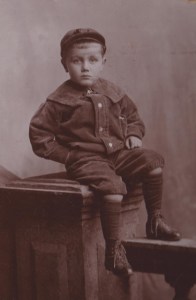
Horace Mapley as a boy

In celebration of 50 years of passing of the Sexual Offences Act 1967, I dedicate this blog to my first cousin twice removed, Horace Mapley (1895-1972).

Horace led an interesting life.  I’ve been told (anecdotally) that Horace was the gentleman’s gentleman for PG Wodehouse (Pelham Grenville, 1881-1975) affectionately nicknamed Plum; Wodehouse that is, not Horace!

Wodehouse, of course, conceived the foolish, gormless Bertie Wooster and his enterprising and cool-headed valet, Reginald Jeeves.

I like to believe my Horace was Jeeves’ prototype but there’s no mention of him in any Wodehouse biography.  All I know is that, for a working class boy from Newport Pagnell, Horace accompanied Wodehouse to the States a few times.

How did how Horace land his job?  In the 1911 census Horace, aged 15, was a page boy living at home at a bakery in Newport Pagnell High Street.    A world away, boarding at a lodging house at the salubrious address of 99-101 Ebury Street, Belgravia, was 29 year old ‘author’ P G Wodehouse.

Following the early death of his father, my grandfather was taken to live at the bakery and the boys were like brothers.     My family regularly visited Horace after he had retired, and I well remember his one small living room at the Revis Almshouses in the grounds of Newport Pagnell Church.  

He was the most delightful and hospitable man serving tea and cakes on doilied porcelain plates; antimacassars and aspidistras everywhere.   The house was spick and span and Twinkle, the budgerigar, chirped cheerfully from his cage. For my amusement Horace let him fly free. After Twinkle died, there was another Twinkle – Horace always gave them the same name.

Horace never married and it was only as an adult I understood why.  That such a fun, sweet, harmless man could have been jailed for his proclivities makes me angry.  I raise a glass to you, Horace, wherever you are.


10 things you didn’t know about Hadfield, Derbyshire – or perhaps you do…

1 The Domesday Book lists Hadfield as Hetfelt, the ‘King’s Land,’ around 4 bovates in size. Its

Hadfield, Derbyshire. The ‘new’ part of town

entry states, ‘The whole of Longdendale is waste. There is woodland, not for pasture but suitable for hunting.’ Longdendale’s value?  40 shillings (£2).   Basically, William the Conqueror swiped the land for recreational purposes…    A bovate, by the way, was an area of land equating to how much an ox could plough in one season which, depending on soil fertility, was between 15 and 20 acres.

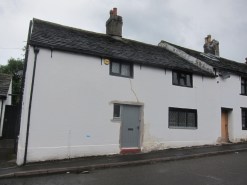
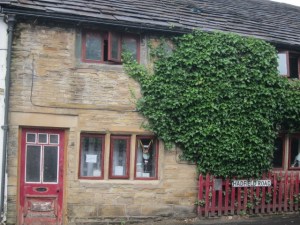
Reputedly the oldest house in Hadfield

2  The oldest house (just opposite the Spinners Arms) is believed to have been a dairy farm in the 1720s.

3  This was before the advent of the cotton industry when Hadfield was a rural village like any other. The original village centre was on Hadfield road near the Spinners Arms which, in 1824, was an ale house

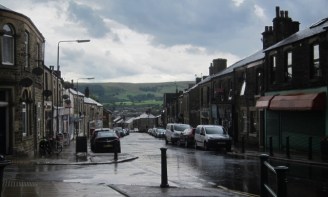
The old part of Hadfield, Derbyshire.  The Spinners Arms is to the right.


4.  In 1861, the Sisters of Charity settled in a small cottage in Hadfield Road moving in 1887 to a purpose built convent in the grounds of St Charles’ Borromeo Catholic Church.  Veronica M Wright was the 47 year old ‘superioress’ in the 1891 census. A Norwich born school teacher, five more female  teachers from Ireland, Essex, Oxford and Dorset lived there too.  The visitor at the presbytery next door, (incorrectly spelled as prespetary by the enumerator)  was Franciscan priest Bruno Knight from Peckham.

The Sisters of Mercy lived here 1861-1887

5  From the 1820s, the Sidebottom family invested in cotton mills and constructed a branch railway directly into their factories.


6   Hadfield Station, when it opened in 1844, was part of the Sheffield, Ashton under Lyne and Manchester Railway and subsequently the heart of the village moved nearer the station.  Nowadays,  Hadfield is the last stop on this line.

7    The 1871 and 1881 censuses record people  born from as far away as Ireland.  Cotton spinner John Doyle and his locally-born family all had mill working jobs in 1871.

8    By 1891, T & W Sidebottom owned the Bridge and Waterside Mills which, between them, had 293,000 spindles for yarn and 4,700 looms for weaving cloth,

9    The part of the railway which stretched from Hadfield to Sheffield (closed 1970) is now the Longdendale Trail for walkers and cyclists.

10  Some scenes for the BBC’s TV programme League of Gentleman were filmed in Hadfield.

Facing World War 1

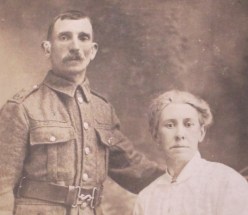
William Henry Smith and Laura nee Petts. ©Adèle Emm

Yesterday was the anniversary of the Battle of the Somme (1 July 1916), the worst day for casualties in British military history with 57,470 casualties and 19,240 killed in action.    This is my great grand aunt Laura Mary nee Petts and husband William Henry Smith taken some time during WW1.  I suspect he was snatching leave from the front and took the opportunity of taking a photo with his loved one.  The expression in his eyes breaks my heart.

He was a ‘carman’ at marriage; today’s equivalent of van driver but his ‘car’ was horse and possibly cart.  Neither he nor Laura were in their first flush of youth at their wedding see the photo below.  Widower William was 33 and Laura 40. They never had children.  In 1911, they lived in three  rooms in Lee, Lewisham.  He was 38 when the war began.

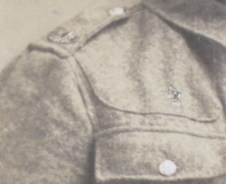
The badge on his shoulder tab (I’m no military historian, so correct me if this terminology is wrong) puts him, I think, in the Royal Engineers….

Detail of WH’s shoulder badge ©Adèle Emm

I’ve tried to find William Henry’s war record.  I’ve scrolled through dozens of William Henry/ Henry William/ William/ Henry Smith combinations but none were the right age or from the right area.  Admittedly, his records might have been amongst those accidentally  destroyed during the Second World War.  I looked on the War Graves Commission website but the only ones without ages gave so little further information, it was impossible.   I even consulted the 1939 register and found Laura but not William Henry.

Did he survive the First World War?  The truth is, I don’t know.

But his face haunts me.

William Henry Smith and Laura in happier times; their wedding August 1909

ostrich farming

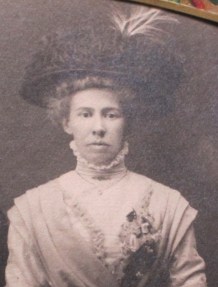
Laura Smith nee Petts wearing a posh hat, circa 1909.  © Adèle Emm

At the turn of the nineteenth century some Emm(s) emigrated to South Africa to run an ostrich farm and, being a curious sort of person, I wondered why.  After all, this was before ostrich steak was a gastronomic delicacy as it is today not that I, as a vegetarian, have ever tried it.

Ostrich feathers!

In the 1880s, after gold, diamonds and wool, South Africa’s largest export was ostrich feathers,

At the height of the ostrich bonanza, a pair of birds could sell for £1,000.   Back in blighty (the UK), a pair of the best feathers could be sold for the eye watering price of, yes, you’ve guessed it,  £1,000!

My great grand aunt is seen here wearing the poshest hat I could find in the family album. This photo was probably taken at her wedding in 1909.

I doubt for one moment her feather is ostrich!   Considering a working class family might pay (depending on location and accommodation) 10s a week rent (£26 a year), you can see how much out of her reach an ostrich feather would be.

By 1914, the ostrich feather industry had crashed completely.    It took just under a year for the market to fail…  Why so fast?

The Boer War (1899-1902) didn’t help….  but what really did for it was a new invention – the horseless carriage.

How could you flaunt your feathers if the wind whipped them off?   And feathers in a roofed car were unceremoniously squashed.  Not only this, but people began to worry about the welfare of birds and animals and killing a bird just for fashionable whimsy was anathema.  Between 1913 and 1914, the industry failed spectacularly. Feathers stored in South African warehouses were worthless.    I think that is when the Emm family returned to the UK.    Please let me know if this is wrong.

Click for more information about the history of ostrich farming in South Africa. 


Emma of Normandy – twice Queen of England and my ancestor???

Queen Emma of Normandy has always been a heroine of mine.  I can hear you ask, ‘Who on earth was she?’ Image result for emma of normandy image

For one, she was twice queen of England. For another, she was the aunt of William the Conqueror and for the third, she is suggested as a reason why the surname Emm exists – Emm being the diminutive of the Norman Christian name Emma.   Sadly,  I dispute this one because Emmerson is a surname in its own right.

However, it didn’t stop me when I was seventeen from researching Emma of Normandy.  Let’s face it, the possibility of descending from a twice Queen of England is a big bonus.

Nobody knows when she was born although it is estimated to be about 985 ad  which means she was still a teenager when she married Ethelred in 1002.  His nickname, as we all remember from school, was Ethelred the Unready,  a mis-translation from Ethelred Redeless which, according to which source you read means ‘noble counselled’ or  ‘ill counselled.’   Another head of state who didn’t listen to the experts.

By Ethelred, Emma was the mother of  two kings, Edward the Confessor, who founded Westminster Abbey, and Harthacnut, who died from overindulging in alcohol at a wedding.

After Ethelred’s death in 1016, she married Cnut (he of the ‘not stopping the waves’ fame) and had yet more sons.  Cnut, incidentally, was much younger than her so the feminist in me says ‘good on you girl’ although, of course, it was largely a political union especially as he already had a ‘hand-fast’ wife, Elfgifu.

There is lots more to Emma this brief blog so I was delighted when she became the subject of a recent  BBC Great Lives (series 42) radio broadcast on 16.5.17 when Sue Cameron promoted Emma.  You can hear it on  by clicking on the link.


Astonishing encounter at WDYTYA?Live at NEC Birmingham 7 April 2017

Have you ever wondered about the witnesses on marriage certificates of ancestors? The ones that are obviously not brothers or sisters of the happy couple? Just after I’d given a lecture at WDYTYALive, a woman from the audience presented me with a wad of paperwork including a copy of one of her ancestors’ wedding registrations.  A witness at the marriage of boot finisher George Watson (aged 21), and Susannah Braham (aged 19) on the 22 September 1888 at St Jude’s Bethnal Green, was Anthony Emm.   His signature, round, cursive, confident, bold as brass stared out at us across the centuries.

The woman had taken the time to investigate Anthony Emm and amongst her papers were printouts of an Anthony Emm born 1873, the son of John Hen(e)ry Emm. Sadly, this Anthony would only have been 15 at the happy couple’s wedding so I think it’s more likely to have been his uncle Anthony Thomas William Emm born 1828 in Bethnal Green baptised 23 November 1828 at St Matthew’s Church. This Anthony TW was a bootmaker and sexton in the 1851 census, recorded again as such in 1881.  George Watson, living in Lark Row just five minutes’ walk from Minerva Street (where Anthony lived all his life) must have known Anthony both professionally and from church.

St Matthew's Church, Bethnal Green © Adèle Emm (640x480)

St Matthew’s Church, Bethnal Green.

Anthony TW Emm’s family is a landmark amongst Emm family historians.  His brother Walter Thomas was implicated in a celebrated murder in 1860 – Walter was acquitted.  I have written extensively about this family so  please contact me for further information.

Who Do You Think You Are/Live is the place to make new contacts, friends and discoveries about the world of genealogy. I had a wonderful day meeting up with the Guild of One Name Studies, Pen and Sword, the Society of Genealogists, Family Tree, and members of various family history societies.  FHS are so helpful and informative, I wish I could join them all. As for their publications, check online for what’s available; FHS have transcribed some fabulous and often obscure archives.

The Pen and Sword Stand at WDYTYA Live

I specifically want to thank the descendant of Susannah Braham and George Watson for giving me a few happy hours delving into both our family histories.  I should have asked for your name!

Manchester Town Hall centenary 2017

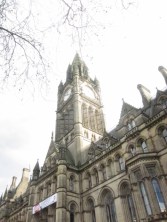
This year heralds the centenary of Manchester’s new (everything’s relative) Town Hall,

Manchester Town Hall showing the tower. © Adèle Emm

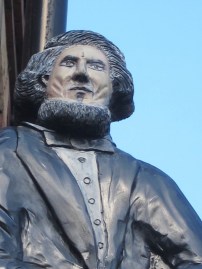
inaugurated September 1877 by the Mayor of Manchester, Abel Heywood of the eponymous pub/hotel in Turner Street.  The Great Abel up in the bell tower was named after him.

I wouldn’t have remembered had I not been conducting some research in the archives at Manchester Central Library for an article on Victorian builders. The new Town Hall was to replace the outgrown one (since demolished) in nearby King Street (constructed 1822-25 ).  The contract to design the new one was put out to tender and the winning plans (not originally the first choice) were by Liverpool born architect Alfred Waterhouse (1830-1905) who also designed (amongst others) London’s Natural History Museum in 1881.

There was some wonderful stuff in the archives especially about the design and appurtenances – who should be represented as statues and wall paintings, which shields should be portrayed, what tunes should be played on bells of the town hall clock…

What fascinated me most was the discussion about tunes to be played on the hour at 3, 6 and 9 including Charlie is My Darling, The Rose of Allandale, Home Sweet Home and God Bless the Prince of Wales which, I am sure, are on You Tube – but not rendered by Town Hall Bells!  John Taylor & Co of Loughborough (website) cast them in 1876 and again in 1936 so the ones you hear on this clip are not the original bells.

Sadly, the bells do not now ring….  not for me… not for you…ting a ling a ling… but they did ring in November 2012. Boy does it look hard work.

For more about the Town Hall bells try.    Apparently it takes two to ring Great Abel because he is so heavy…

IMG_7900 (480x640)

Did Abel Heywood have a loud voice? Is this why the largest bell in Manchester Town Hall was called The Great Abel?

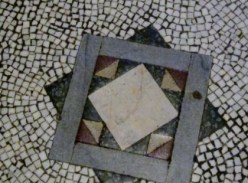
According to a security guard at Manchester Town Hall, this is the foundation stone laid by Mayor Robert Neill 26 October 1868. If it isn't, please tell me. © Adèle Emm

According to a security guard at Manchester Town Hall, this is the foundation stone laid by mayor Robert Neill on the 26 October 1868. If it isn’t, please tell me and also where the correct one is.

© Adèle Emm

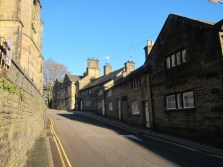
Old Glossop, Derbyshire

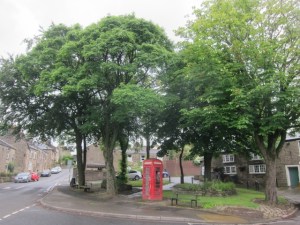
Old Glossop. All Saints Parish Church is to the left.

Old Glossop. All Saints Parish Church is to the left.

It was a beautiful day and I had just discovered my 5 x great grandfather, carpenter and joiner John Newton, had been baptised on the 23 July 1751 in the parish church of Glossop, a pleasant drive from here. Why not pop off and take photos for some newly discovered Californian cousins  also directly descended from this chap?    The eighteenth century Newtons would not recognise the main drag of ‘new’ Glossop built along the A57, the main road traversing the Pennines and about a mile from Old Glossop.

graveyard of All Saints Parish church, Glossop

graveyard of All Saints Parish church, Glossop

Old Glossop is a fabulously atmospheric place and I like to think John and his family would recognise some  old cottages even though they hailed from Hadfield, a few miles away.

Sadly, they would also no longer recognise All Saint’s Parish Church rebuilt in 1831 (the nave) and 1853-5 (the tower and chancel). Being a weekday, the church was locked.   Heigh ho…   However, the graveyard still exists and the gravestones appear intact although, with the current obsession for health and safety, they have been lowered flat in order not to squash vandals kicking them down.    Ironically, walking across the gravestones was slippery and equally dangerous – could I sue for a broken ankle?   I found some Newton gravestones, sadly not mine.

Glossop market cross. The shaft probably dates from C15. It is believed a market has been held here since the 13th century.

Glossop market cross. The shaft dates from c C15 and it’s believed a market has been held on this site since the 13th century.

Newton derives from a place name; ‘tun’ is Anglo Saxon for settlement, farmhouse or fortified house.   A popular Christian name for my Newton branch is ‘Thurston’ which crops up a lot throughout the generations.   Thor, of course, was the Scandinavian/Viking god of war and stone/stein is self explanatory.  I haven’t got to the bottom of its use in the family.