Trump Street is trumped

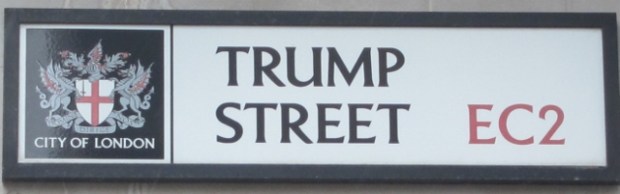
Trump Street (640x201)Indeed!  And the origins?  A quick Google reveals that 18th century Trump Street was Trumpadere Street and one gentleman who lived there was a William Trompeor , a trumpet maker supplying horns for local watchmen.

Little Boy Blue come blow your horn,

The sheep’s in the meadow, the cow’s in the corn.

But where is the boy, who looks after the sheep?
He’s under a haystack, fast asleep.
Will you wake him? No, not I,
For if I do, he’s sure to cry.                                            sprang to mind

For those of you with a less whimsical turn of mind, the original City of London was rebuilt following the disastrous Great Fire of London 1666 (see my previous blog).  In 1720, Trump Street may have been known as Duke Street.  The City was devastated again in World War 2, and largely rebuilt. Trump Street included.

Trump Street leads into Russia Row….


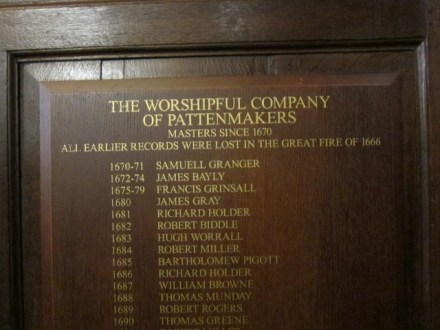
Masters for the Worshipful Company of Pattenmakers,  St Margaret Pattens Guild Church, Eastcheap

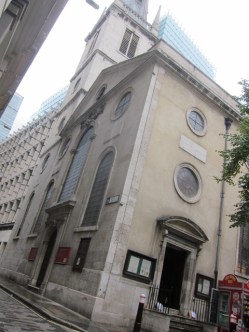
St Margaret Pattens is in Eastcheap, the City of London and is the Guild Church for the Worshipful Companies of Patten and Basketmakers.

St Margaret Pattens, Cheapside, exterior (480x640)

Guild Church of St Margaret Pattens © Adèle Emm

Pattens? Wooden ‘over shoes’ worn from at least the twelfth century to elevate and protect shoes and skirts from the ravages of mud and muck in streets and roads.  Jane Austen (1775-1817) wore them in Steventon, Hampshire.  Why don’t we wear them? Because the state of our roads is now so good (?) they haven’t been worn since the early twentieth century.

St Margaret Pattens, pattens display (640x480)

Wooden patten in display case at St Margaret Pattens

Founded in 1067, St Margaret Pattens was destroyed in the Great Fire of London, 1666, and rebuilt to Sir Christopher Wren’s design between 1686-1688. It’s one of the few City churches to survive the devastation of both World War One and Two so, not only have Christopher Wren’s original features remained, but so have the wooden notice boards listing Guild Masters from 1670 (earlier records were lost in that pesky 1666 fire..)  If you have a member of the Pattenmakers’ guild in your family tree, this is the place to come.  The church entrance also holds a small display of artefacts from both Worshipful Companies.

St Margaret Pattens, Worshipful Masters' names (640x480)

The Masters’ noticeboard in St Margaret Pattens Guild Church

I heartily approve of the  Worshipful Company of Patternmakers.  Why? Because their motto recipiunt fœminæ sustentacula nobis  translates as ‘women receive support from us’.   Good on them!

For more information on guilds, refer to my Tracing Your Trade and Craftsman Ancestors.


Elizabeth Raffald, superwoman

Let’s start with a short CV.  What would you think of a person who:-Elizabeth Raffald.jpg

  • set up and ran the first employment agency
  • ran two local newspapers, a shop and at least two pubs
  • published a trade directory
  • wrote a book on cookery and housekeeping?

Highly employable eh? Would you give them a job?  The bad news is, you can’t.  She died in 1781 aged just 48.

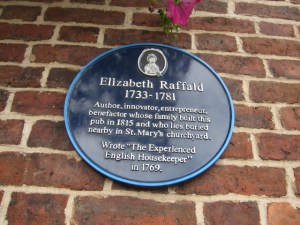
Elizabeth Raffald, born in Doncaster in 1733, worked as housekeeper for the Warburton family at Arley Hall, Cheshire, later dedicating her cookery book to the Hon Lady Elizabeth Warburton. It was here she met her future husband, their head gardener John Raffald/Rafford.  The couple moved to Manchester circa 1763 to run a confectionery shop and seed business.  She founded a register for servants (the job agency), published Manchester’s first trade directory in 1772, and wrote The Experienced English Housekeeper for the use and ease of Ladies, Housekeepers and Cooks & Co. She sold the copyright for £1,400 – an absolute fortune in those days.   The 10th edition, published posthumously in 1786 can be found online.  She even squeezed in giving  birth to sixteen children, all  girls, although only three were to survive.

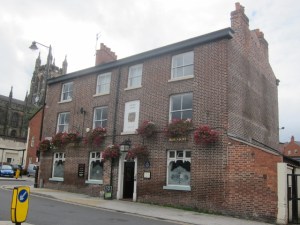
Arden Arms, Stockport. St Mary’s Parish church can be seen in the background. © Adèle Emm

Her brother in law ran a pub in Stockport, the Arden Arms.  It was here she died in 1781 – were they visiting relatives?  Buried in the Raffald family plot of St Mary’s graveyard, the parish register records her as a Manchester resident.  The Arden Arms is still overshadowed by St Mary’s.

History is unkind to John; it seemed he liked his liquor and, after Elizabeth’s untimely death, his second wife was described by all and sundry as, um,  stupid…

Elizabeth’s blue plaque on the wall of the Arden Arms. © Adèle Emm

Rosa Leo Grindon, another forgotten suffragist

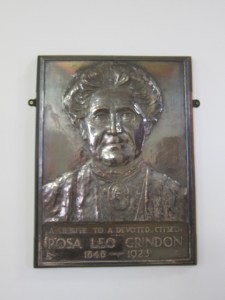
Rosa Leo Grindon 1848-1923, plaque in Manchester Central Library foyer

Back to my theme of forgotten suffragists.  In the foyer of Manchester Central Library is a bronze plaque to

Rosa Leo Grindon, 1848-1923    A tribute to a devoted citizen 

Rosa Leo Grindon?  Who she? Even Google was vague though it rustled up the plaque designer, John Cassidy.

Ancestry reveals the bare bones of Derbyshire-born Rosa née Elverson. Her father was a labourer in 1851; by 1861 he had risen to grocer/draper – i.e. in  much maligned ‘trade.’ Somehow, somewhere between 1891, (when she is a ‘lady housekeeper’ to a Lichfield brewer) and the September quarter of 1893, she meets and marries 75 year old widower, Leopold Grindon, her senior by 29 years. They are living together in the 1901 census.  He died in 1904 and in the 1911 census Rosa is ‘lecturer and suffragette’.   Yes!

I’m always reiterating not everything is on the internet… finding more about Rosa required a trip to Manchester Central Library to view correspondence collected by Mr Cummings Walters, editor of Manchester City News.  Bingo!  Rosa LLA, FRMS, was Chairman, Honorary Secretary for Prizes and Assistant Treasurer of the Manchester Shakespeare Tercentenary Association, an organisation which she founded.  Also included were her letters re; new-found interest, spiritualism. Further evidence of this  was provided by a newspaper clipping for a meeting held by Sir Arthur Conan Doyle of Sherlock Holmes’ fame.  Winding through microfilm of City News I found her obituary  including photographs (P6, 12 May 1923).  Superwoman Rosa had attended Cheltenham College sitting her examinations (remember, many universities didn’t permit women to matriculate) at St Andrews University in ‘English literature, Anglo Saxon, botany and geology, a first class in physiology and a second class in economics’.  As a girl, she’d been ‘a fearless rider to hounds’ (fox hunting).  She’d visited  ‘America as a suffragist’ but ‘was not aggressive in the women’s movement’.  This intrigues me. Why had she classed herself in 1911 as suffragette not the less militant ‘suffragist?’  We may never know.

 Manchester Town Hall is currently closed for renovation until at least 2024. The statues, plaques, memorials etc have been moved for safekeeping.  Is our Rosa’s plaque one of these? If so, she has risen from the obscure….   Good on you!


Women and WW1 War Memorials

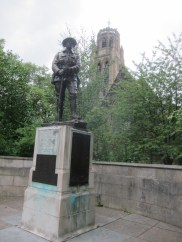
Heaton Moor War Memorial outside St Paul’s Church © Adèle Emm

700,000 British men were killed in World War 1, their names inscribed on War Memorials in hamlets, villages, towns and cities all around the country.  I’ve also seen plaques in post offices, hospitals, foyers of old  buildings, outside funeral directors, on church lychgates… but the names are invariably those of men – but women did die in the First World War!  Some nurses lost their lives on torpedoed hospital ships (e.g. Miss Kate Beaufoy on HMHS Glenart Castle February1918), some from military action, many from illnesses – Spanish flu (with a higher mortality rate than the War itself) and pneumonia.

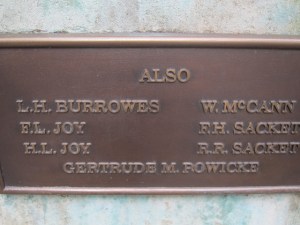
On the back of Heaton Moor’s war memorial outside St Paul’s Church, Stockport, the name Gertude M Powicke is found, the plaque clearly placed retrospectively.   Who was Gertrude? Following a degree in languages from Manchester Victoria University, Gertrude was teaching at Manchester High School for Girls  when war was declared. Her skills in languages being invaluable, she joined French Quaker nurses in France to help with refugees and her letters home are at held Manchester University.  After the war, she travelled to Poland to assist those affected by a typhus epidemic and there, on the 20th December 1919, she too succumbed; news of her death reached British newspapers by January 1920. She was 31.

Memorial to Gertrude M Powicke © Adèle Emm

I haven’t discovered the date when her name (with six others) was added to the memorial. Your suggestions appreciated… From at least 1923 until his death in 1935, her father, congregational minister Frederick Powicke, lived about a quarter of a mile away at 4 Langford Road, Heaton Chapel.

I know of no other women commemorated for their ultimate sacrifice in WW1 apart from Edith Cavell and Kitty Trevelyan.  In 1915, Cavell was shot by the Germans for harbouring allied soldiers; one monument (there are others) stands outside London’s National Portrait Gallery. Nineteen year old Kitty Trevelyan’s name was added to Meavy war memorial, Devon, in February 2017. Serving with the Army Service Corps, she died of measles and pneumonia in France. Like Gertrude, never returned home.

Emm Waifs and Strays 1939 Register

Why have I not updated my blog recently?  Because I’ve spent days and days collating all Emm(ses) in the 1939 register – over 300 now and still counting….

The 1939 Register was compiled for national security reasons when the British Government was faced with the prospect of all-out war.  It is one of the UK’s most important documents of the 20th Century and crucial for family historians bridging the gap between the 1921 census (unlikely to be released before 2022 due to the cost and effort of digitisation) and the destruction of the 1931 census by enemy action. An individual’s ID card number became their NHS number at its foundation in 1947.  It listed all civilians living in the UK in 1939. Military personnel were not listed unless they were on leave when the register was being conducted.

My forays into 1939 have been fascinating, illuminating and unbelievably frustrating! You can’t believe the number of Alfreds, Alberts, Mildreds, Georges, Daisies (plural of Daisy anyone?) Who is who?   And when an Emm was obviously living away from home, trying to match a a husband and wife living and working elsewhere was horribly time consuming.

One little lad, for instance, Thomas Emm, aged 6, was in Langwith  Isolation Hospital, Blackwell, Derbyshire.  It took me ages to work out his parents were Samuel Emm (colliery hewer heavy worker born 1893) and wife Avis (nee Whitfield) who lived just down the road at 70, the Woodlands, Blackwell.    This isolation hospital, opened 1908, treated infectious diseases like diphtheria and scarlet fever.  Thomas’ treatment was clearly successful as he married in 1957.

The Blackwell Rural District Council Annual Report of 1938 (the same time the 1939 Register was compiled) is a fascinating statistical insight into the area including the number of privies, middens, condemned housing etc – stuff you wouldn’t normally discover…

Information (continuously updated until 1952) revealed in the Register  includes name, address, date of birth, gender, marital status (widowed, married or single) and occupation. The majority of women were performing ‘unpaid domestic duties’.  This is transcribed online but viewing the original document reveals crucial defence-of-the-realm annotations like ‘ARP’ and ‘air raid warden’. Even more useful is when a woman’s surname is crossed out with a handwritten amendment (often in a different colour ink) stating her post 1939 married name.

For anyone still alive, their details are obliterated by a black bar and ‘closed record’ however, this gives a clue to any children a couple may have had.

See the National Archives page for more information. The Register can be accessed at subscription sites Ancestry and FindMyPast, often accessible for free at public libraries.

A reminder, if you are an Emm, descended from an Emm, or married to an Emm, you can discover more at our next Emmposium taking place in Wiltshire on the late May bank holiday 2019.  Please contact me for details.  Our Emm trees are now even more informative and over 70 feet long!  You have been warned….
Wotta stunna!

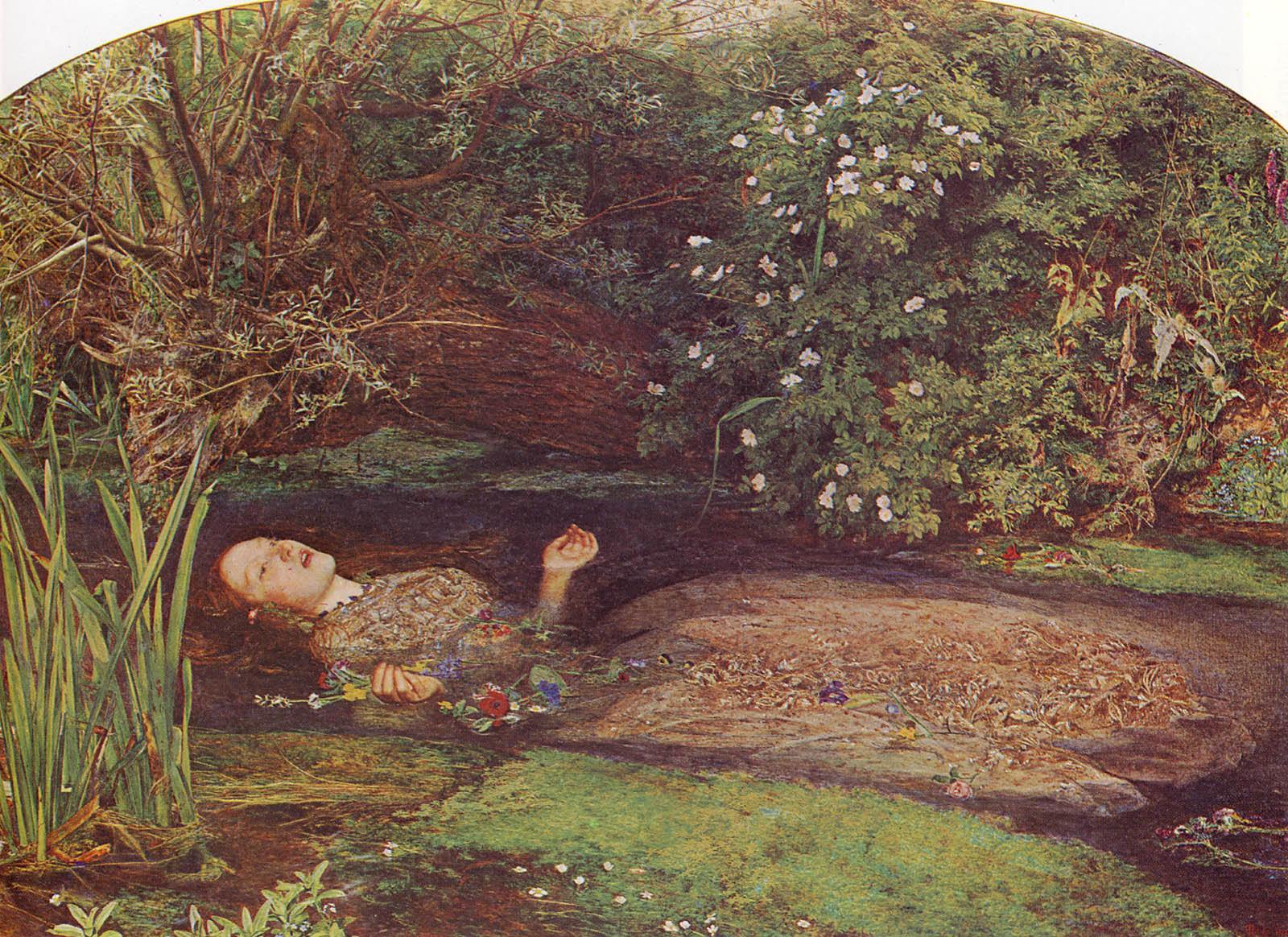
John Everett Millais. Ophelia. circa 1851

What a very modern expression!  No, actually, this dates to the 1860s when pre-Raphaelite artist Dante Gabriel Rossetti (1828-1882) coined the now horribly non-PC expression ‘stunner’ to describe a beautiful,  enchanting woman.  In 1848, he was one of the founder members of the artistic movement, the pre-Raphaelite Brotherhood.

Being a somewhat naughty chap, Rossetti usually persuaded these stunners to pose for his paintings and several became his mistress.  Elizabeth Siddal (1829-1862), an artist in her own right, became his wife.  She’s most famously depicted as Ophelia and one suggestion for her early death is due to the time spent immersed in cold water whilst Millais painted her.  Like many of Rossetti’s muses, Siddal was a redhead.

La Ghirlandata. Dante Gabriel Rossetti. Displayed at the Guildhall Art Gallery, London

Redheads have always had a raft of pejorative nicknames thrown at them. L M Montgomery’s eponymous heroine, Anne Shirley of Green Gables, famously verbally attacked anyone commenting on her red tresses and even smashed a slate over Gilbert Blythe’s head when he called her carrots.  Rossetti is amongst the few who celebrated auburn locks focussing on their  ‘cult of beauty.’  Another of his famous red headed models was Alexa Wilding (1847-1884) depicted in one of his most famous paintings La Ghirlandata (circa 1873).    This wonderful picture can be viewed at the Guildhall Art Gallery, London.

For Rossetti’s biography and some online examples of his work see the Tate website.

Foteballe and Amphitheatres…

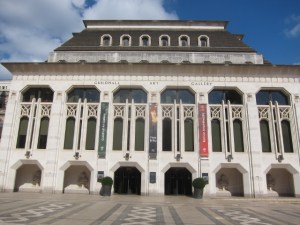
Guildhall Art Gallery

Yesterday was not a good day for English football; 2-1 to Croatia.  However, English football has had worse days.  Like 1314 when the then Mayor of London, Nicholas de Farndone, banned football entirely!  Why do I know this?  Because I’ve just had a fabulous time in the Guildhall Art Gallery which, as a bred Londoner, I really should have visited before…   I have a genuine excuse; this building was completed in 1999 replacing the one destroyed in the Blitz in 1941.  It’s fabulous!

I initially went to see John Whitehead Walton’s 1873 painting of The First London School Board where, amidst a sea of male faces, are those of two of my favourite ladies,  Mrs Elizabeth Garrett Anderson and Miss Emily Davies both in the forefront of female emancipation; one for medicine and the other education.

Alongside this important painting is a plethora of pre-Raphaelites and other paintings depicting old London etc and, of course, the story of banning foteballe. There is even a copy of the Magna Carta!

Emily Davies is bottom left. Elizabeth Garret Anderson behind her. Courtesy Guildhall Art Gallery.

The Art Gallery is built above the London Roman Amphitheatre.  Head  to the basement to see it in all its theatricality.   Experts and archaeologists had all agreed London must have had a Roman amphitheatre – but it was only discovered in 1985.  It is now, of course, a protected monument and, like the rest of the exhibits at this Art Gallery, free to visit.

I was not the only woman walking around the art gallery with a smile on my face (remember, this is before England lost the match…)   Another was beaming ear to ear about its largesse. She, too, had never been and she was a London tour guide.  That made me feel better.

If you are in this fascinating area of London, pop next door to the rebuilt Wren church, St Lawrence Jewry, destroyed in the Great First of London 1666 and again during the London Blitz.

on tenterhooks; textile mill jobs lecture at Society of Genealogists

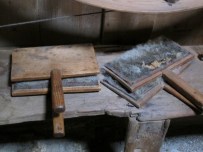
Hand carders for wool

You aren’t too late to book a seat at my lecture on Wednesday 11th July at 2pm – that is unless you are reading this on the 12th and have missed it.

The lecture is about deciphering those provocatively named cotton and wool textile mill jobs; scutcher, feckler, tackler, tenter, doubler and carder plus all those other weird and wonderful ways our ancestors earned a mill crust in the censuses.   My grandmother, by the way, was a reacher in the 1911 census. She was  13.

My father designed spindles for spinning machines until the bottom fell out of the textile industry (pun intended).  He travelled to Lancashire, Cheshire, India, Switzerland and possibly even North Korea (don’t ask – I’m still trying to prove it was North not South because he said the plane was hush hush, nobody had passports with them and the coach in Korea had boarded up windows… ).  But he never went to Yorkshire.  Why not?  Because Yorkshire was a wool county and his spinning machines were for cotton.

So I look forward to joining you next week to learn what this has in common with this.

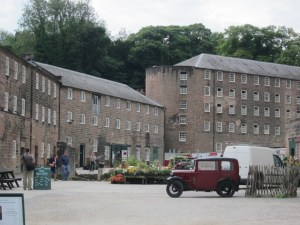
Cromford Mill, Derbyshire

Thomas Paine, District Nurses and Peterloo – What do they have in Common?

Well there’s a good question!  Answer – The Working Class Movement Library, Salford.

Working Class Movement Library, Salford

This fabulous library is where district nurses used to live (the rooms housing the collection are former bedrooms), copies of Thomas Paine’s (1737-1809) controversial writings are held and a contemporary map of St Peter’s Fields planning the strategy for the now infamous gathering hangs on an upstairs wall.

A confession; although I knew of this library’s existence and have written about it, until Saturday, I’d never been. From the outside, it’s just a detached house but the inside is a cornucopia of treasures largely collected by Ruth and Eddie Frow who originally housed their library in a three bedroom semi in Stretford.   They must have slept in a cupboard…

The collection was moved to the current site opposite Salford Art Gallery in 1987 and it has become one of the most important repository for books and pamphlets about the working class.

Let’s face it, today the term ‘working class’ has connotations of skivers and scroungers but of course, the working class was society’s backbone; our ancestors beavering away as shoemakers, cabinet makers,  bookbinders, carpenters, watchmakers, spinners and weavers  and shopkeepers – everyone who worked for a living to survive – all of us. They were the working class and this library celebrates it.

Research and entrance to the library is free, see their website for catalogue details. Contributions are extra welcome.  I shall be returning soon – I want to discover more about my grandfather’s contribution to the General Strike, 1926, Did he know the Frows?