Hurray for Fawcett, down with Pankhurst

File:Photo of Millicent Fawcett.jpg

Millicent Fawcett

Emmeline Pankhurst

I make no apologies for the above       statement.   Millicent versus Emmeline –   Milly wins hands down.  I have  been   reading a book which  made me realise what an appalling woman   Emmeline Pankhurst was;  Hearts and Minds by Jane Robinson.  And in the week when a statue of Fawcett has been unveiled in Parliament Square and a friend told me  Stockport, following a competition to name a new square, has ignored  the suggestions and gone with Suffragette Square – this is a topical subject.

How dare they name a public square after an autocratic female thug who has nothing to do with Stockport!  Yes, her daughters were educated in Manchester and the former family home, the Pankhurst Centre, is adjacent to Manchester Royal Infirmary, but did the woman ever visit the town?   That’s a rhetorical question; I neither know nor care but, if anything, Stockport should have named it Suffragist Square – not Suffragette.

Do I hear you mutter ‘Not much difference’?  Well there’s a huge difference between the suffragist and the suffragette movement.  The suffragists believed in female franchise and female equality and their struggle began circa 1860.   -Ette is a French suffix for something small, a pejorative term, (kitchenette; a little kitchen and that’s where women should be).  Suffragette, coined in the early 1900s, was a deprecatory term used against women and applied with a sneer. Suffragettes, under the slogan ‘Deeds Not Words’ embarked on a terrorist campaign and, yes, suffered cruelly under the male government and at least three women died.

To recap. Stockport has given a public square a pejorative term for women.

But to be positive, I want to give thanks to the wonderful Millicent Fawcett (1847-1929) and her sister Elizabeth Garrett Anderson (1836-1917), the first woman who qualified in England as a doctor. These two deserve their plaudits – too-long-a-coming…

Finally, to name the suffragettes who died in the struggle for women’s suffrage.

  • Mary Jane Clark, (1862-1910). Emmeline Pankhurst’s younger sister died Christmas Day 1910 a few weeks after Black Friday, 18 November 1910, when a peaceful women’s suffrage march was attacked by police.
  • Henria Williams,(1867-1911) who also attended the march, gave a witness testament on police brutality and died of heart failure New Year’s Day 1911.
  • Most famously, Emily Davison (1872-1913) died of her injuries from being kicked by the King’s horse during the 1913 Epsom Derby.

Why all the fuss this year?  Only a few women achieved the vote in 1918 – married ones over 30 whose husbands fulfilled a property criteria or if she had a university degree.  Fast forward to 1928 – when Millicent Fawcett cast her vote for universal suffrage….  All her fabulous work and she survived to take advantage of what she had so peacefully campaigned for.

Turnip Power – or how to save money with a vegetable!

Yes, a tiny diversion from my current theme of important albeit largely forgotten women but I’m sure you’ll agree, in our age of environmental concerns this topic is also of relevance today.

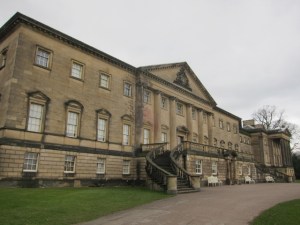
Nostell Priory near Wakefield. National Trust

There is a cheap bio-fuel which burns brightly, doesn’t smell and doesn’t cost the earth.  The name of this magical elixir?  Colza Oil.

Never heard of it?

Neither had I until I visited National Trust owned Nostell Priory near Wakefield, a splendid pile built by the Winn family who, like all aristocracy , were so concerned with penny preservation  that they installed the latest technology in 1819 in their salons – lamps blazing from oil extracted from locally grown turnip seed, similar, I guess, to rapeseed oil.

Turnip-oil lamps were invented by Frenchman Aimé Argand in the 1790s and, for a short while, powered French lighthouses as well as, also briefly, American lighthouses (from the 1850s). Unhappily, the oil is so viscous (making it difficult to rise up a wick) and too difficult for the Americans to source (presumably they didn’t go in much for turnips) that they stopped using it.

Nostell Priory has several beautiful examples of colza oil lamps including ceiling candelabra.

The vogue was not to last in the UK either.  Patented in 1850, paraffin was far cheaper and less viscous so quickly supplanted colza oil to become a popular lamp fuel for less affluent households.

When our gas runs out through government mismanagement, global politics and environmental catastrophe, you now know what to do.

Grow turnips.

the humble turnip

Farmer’s Friend, unsung Victorian heroine

EleanorAnneOrmerod.jpg (177×173)

Eleanor Anne Ormerod

In the year of female enfranchisement (for some) I’m continuing my eulogy of forgotten and clever women who fill me with admiration although I’m sure I would’ve been intimidated should I have met  them.

Today’s is a self-educated woman who could read Latin, French, German, Italian and Spanish and, using a dictionary,  translate Russian, Dutch and Norwegian. I bet you’ve never heard of her.

Eleanor Anne Ormerod, 1828-1901, was an entomologist and scientist who studied insects injurious to crops and became;

  • an adviser to the Board of Agriculture 1885-1890;
  • a Fellow of the Meteorological Society,  1870:
  • awarded  gold and silver medals from the University of Moscow
  • awarded (before women were allowed a university degree even they could follow the course and sit the exams) an honorary degree of doctor of laws from Edinburgh University in 1900 – the first woman ‘to be so distinguished.’

She wrote many books and papers, lectured in America and Europe but like so many intelligent women, never married. Her death was reported  in newspapers throughout the country and her estate was worth more than £52,000 – all from the fruits of her own labour and intellect. Go it girl!

Her archives, books and papers are held at the Museum of English Rural Life, Reading University.


Bodnant Hall, Gardens and suffragism

Question?   What has Justitia, the Mayor of Salford and female emancipation got in common with Bodnant Hall?

Bodnant Hall Gardens 2001 © Adèle Emm

Answer:

  • Justitia was the nom do plume of Agnes Pochin née Heap, a supporter of women’s suffrage.
  • She was married to Henry Davies Pochin, one time was Mayor of Salford, and supporter of The Cause.
  • In 1874, stupendously wealthy soap-making industrialist, Henry, bought Bodnant Hall and moved in with his family. As a fanatic gardener, his legacy was designing the gardens now owned and administered by the National Trust.  Bodnant Hall is the Welsh family home of Lord Aberconway and, although you can see it across the garden lawns, it’s not open to the public.

However…. this is the end of the story not the beginning!    I’ve a curiosity addiction so can’t leave any stone unturned (seemingly a disgraceful addiction to mixed metaphors too).

I fell across Timperley-born Agnes Pochin (1825-1908) whilst researching female emancipation for my current book.   A friend of Lydia Ernestine Becker (previous blog), she accompanied Lydia on their first outing  to speak at Manchester Free Trade in 1868 for the Manchester Society for Women’s Suffrage. This was a big deal especially as Agnes, married to the chair of the meeting, the  Mayor of Salford (Henry) meant she was accused of abandoning her children at home!  One of her daughters was Laura Elizabeth Pochin (1854-1933), who, it’s been suggested, wasn’t languishing at home in Salford, but snuck somewhere at  the Free Trade Hall listening to mum’s speech. Laura also embraced The Cause.

Leicestershire-born hubby Henry (1824-1895) was somewhat a genius who invented (amongst other things)  a way of making rosin (used in soap manufacture) white rather than a sludgy brown. He sold the rights to make his first fortune.  See his Grace’s Guide entry.   He, too, supported The Cause.

In 1877, nine years after the Free Trade Hall meeting, Laura Elizabeth Pochin married Charles Benjamin Bright McLaren, also in Grace’s Guide.

Now we get politically incestuous.   Charles was the son of Priscilla McLaren née Bright (1815-1906), sister to John Bright, an influential free trader and celebrated MP who sadly (boo hiss) did not support the suffrage movement.   This must have provoked a few family arguments as both sister Priscilla and younger brother did.    John’s brother Jacob Bright MP was very active in Manchester, and good friend of both Agnes Pochin and Lydia Becker.

We can trace Agnes’ life through the census records.  In 1871 she and hubby Henry are living at Barnes in London, nearer the centre of his political life in Westminster.   1881 also sees Agnes, now a proud grandma presumably helping out with Laura’s two children, an 8 month old and 1 year old toddler.  Husband Henry Pochin is at Bodnant Hall tending  his plants.   In 1891, both Agnes and Henry are in Wales with a ten year old visitor – no longer that baby in Barnes…   There are a heap (sorry) of servants.

Charles McLaren became the lst Baron of Aberconway. When Agnes died (12 February 1908), she left her estate, £16,818 9s 8d  to daughter Laura.

Agnes is buried in Bodnant Hall garden.     Click to see photographs via the National Trust site, of Agnes, Priscilla and Laura..


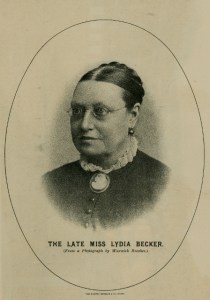
Lydia Becker (1827-1890), the feminist you’ve never heard of

Miss Lydia Becker courtesy LSE Women’s Library

To misquote Hilaire Belloc, son of a suffragist but anti-suffragist   himself , the following excerpt from an  Ode to Lydia Becker will make you stretch your eyes.

In 1867, women had no vote but Lydia campaigned to remedy the situation and was one of the first women in the UK to speak in public.  In response to her campaign,  a self-styled ‘author’ penned this.

Oh, maiden with a charming name,

But with a most unseemly mission,

Why to the franchise lay a claim

When marriage should be your mission?

Women their province best fulfil

When prompt to soothe, and not defy, men

And, shy of trusting Mr Mill,

Rather repose their faith in Hymen.

Women were expected to stay home.. Even daughters of wealthy businessmen had a rudimentary education.  A husband legally owned his wife,  her possessions before marriage became his, and should they separate, the children remained with him.  Not only this, but women never went to public meetings except church and she certainly couldn’t speak at one.

Lydia Ernestine Becker, a chemist’s daughter from Manchester (he owned a vitriol works at Middleton Junction on the outskirts of the city), home schooled by a governess and self educated, was amongst the first women in the country to speak in public. And on a political platform no less.  Scandalous!  From her first venture as orator, she travelled the country speaking on female issues at venues as prestigious as the Mechanic’s Institute, Leeds, and Manchester’s Free Trade Hall.

The Second Reform Act was passed in 1867 permitting ‘persons‘ who owned property to vote.  Taking the Act at its word,  Lydia persuaded 5,000 eligible women to enter their names on Manchester’s electoral register.  Sadly, most were weeded out before election day but a handful of names slipped through.   Lilly  Maxwell, a Scottish born widow, was one. She cast her vote for Jacob Bright, the candidate espousing women’s suffrage.    Remember, this was fifty years short of official female enfranchisement.  As soon as the by-election closed, the government reworded the Act and women were banned from voting until 1918.

As can be expected in a world when women were powerless, Lydia was treated with contempt and ridicule for daring to speak in public  especially in support of women’s rights.  Subject to a barrage of vitriol (I couldn’t resist referring to daddy’s trade) she became adept at rebuffing hecklers.

As evidence of how far women have travelled since the 1860s, I have copied part of William Gaspey’s Ode to Lydia Becker published in the Cumberland Pacquet and Ware’s Whitehaven Advertiser on 20th October 1868.   Originally  from London, Gaspey was a bookseller and author living in Keswick.  His wife, Jane, was fourteen years his junior and I’d love to know if she agreed with his ideology.  I didn’t have the heart to copy the entire doggerel; at six stanzas, it was patronising to a fault.

This is how it continues…

Few of the fair sex who are blest

With husbands care a pin for voting:

No dream of suffrage stirs the breast

Of tender wives, or mothers doting:

More prescient than ‘strong minded’ dames,

To them far nobler nursery morals,

And joining in their children’s games,

Than dabbling in election quarrels!


Helpmeet for man was woman made,

To cheer him with her love and beauty,

But when a demagogue’s her trade,

Vanish both modesty and duty.

On platforms, she is out of place,

And meets from law no recognition –

Sweet Polly loses all her grace

Transformed into a POLLY-tician!

and  on and on and on….


Postcode Lottery; the hidden life of a Manchester street

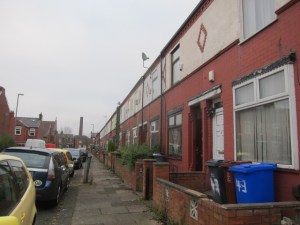
Molyneux Road, Levenshulme, Manchester, is one of those nondescript drive-past-and-you-miss-it turn-of-the-century terraces seen around the country especially in the North West. This is a social snapshot of families living there just after the houses had been built.

The 1908 Ordnance Survey map shows the neighbouring streets but no sign of the nascent 22 houses eventually constituting Molyneux Road: except this map was out of date because there were already six houses, numbers 1 to 11 forming their own little self-contained block (RG13/3692/0228-0229) and enumerated in the 1901 census.

Molyneux Road . Nos 1-11 in foreground. © Adèle Emm

Although they are quintessentially two-up two-downs, the houses here have gardens not backyards and nor did the front doors lead straight onto the street; this was a desirable address.   The residents had ‘cut above’ jobs too.   In 1901 Robert Jamieson at number 1, George Atkins at 3 (still living there in 1911) and John Booth at number 11 were clerks (insurance or mercantile); a retired widower and his family lived at number 5, and a warehouse porter and stone mason at 7 and 9.

By 1911, the road was complete with houses from 1 to 43 just as today.  Living at the far end at 43, perhaps the last house to be built, were three single women; sisters, Annie (53) and Elizabeth Smith (46) and their lodger, assistant teacher Mary Dixon (21), who worked for Manchester Corporation.  Elizabeth was in the up-and-coming communications industry, a GPO telegraphist.  Their house, slightly larger than the others, had five rooms (not including kitchen, scullery or bathroom) so each had her own bedroom sharing living space downstairs.  What struck me most was that hardly anyone in the road worked in the cotton industry.

43 Molyneux looking towards industrial Levenshulme at the far end of the street. © Adèle Emm

I don’t need to remind anyone that this was three years before the devastation of World War One when Molyneux’s young men must have been desperate to join the fray.   In 1911, 12 year old Horace Statham lived at number 5.  Next door but one, at number 1 lived 11 year old Reginald Harry Bembridge with mum, dad and siblings.  Reggie was their eldest son.   There’s no way these lads couldn’t have known each other;  were they friends, did they play footie in the street and attend the same school?   Horace joined up, aged 20, in September 1918. He still lived at number 5, was a turner by trade, 5 ft 4 inches tall, with light brown hair, blue grey eyes and a mole on his left cheek.   Reggie’s family had moved round the corner to 199 Broom Lane. Tragically, a month after Horace joined up and a few days before Armistice, his pal  died of wounds, 24 October 1918. Private R H Bembridge is buried a long way from Manchester at St Aubert British Cemetery, France.

Another participant in WW1 was George Edward Dunn from number 31 at the other end of the road. He, too, was 11 in 1911, and probably knew the others as they were the  same age.  When he signed up in May 1917 aged just 18, he was a titch of a lad at 5 ft 3 with a 33 inch chest and expansion of only 3 inches, fresh complexioned, grey eyes and auburn hair. Most of his ‘theatre of war’ was in the reserve but a note  shows him forfeiting 8 days pay.  What happened?  He was given 14 days leave (17.8.19 to 9.9.19) to travel back from somewhere in the Rhine to the UK via Calais.   I bet he went to visit mum, widowed during the course  of the war and he was eight days late returning to base.   Ominously, the note reads ‘disciplinary action taken; but, unlike poor Reggie, George survived.

This link is to the National Library of Scotland map for 1894 clearly showing field boundaries, local works, dye, print and wire-mattress makers. The area was still relatively rural; the houses that would mushroom up but a twinkle in the builders’ eyes.  

Licence to Snoop

william_hogarth_027

The Rose Tavern, Covent Garden, scene 3 from The Rake’s Progress, c 1734, William Hogarth (1697-1764)

I am a detective at heart invoking my snoop licence.  For me, genealogy doesn’t stop with a name, it’s the story behind it.

I recently went to the British Library to view a book so ‘hot’, I had to sit in the Rare Manuscripts Reading Room under the nose of the librarian.    They weren’t supervising me because it was 1841 porn, or that it was written anonymously (no guesses why). It’s because only a handful of these,um, directories survive worldwide

The first half was pretty bland.  The anonymous debauchee lists the swishest places a gentleman of the town could drink, gamble, play  billiards and cards, meet a girl and have an undisturbed smooch in a private box at the theatre.  The author didn’t mean a smooch; this was not that kind of book.     He also named places to avoid.  You know the type; hangouts raided by the police, dives where you’re stabbed in the back (literally), or punched in the stomach for a few pennies in your purse…

But then our anonymous friend arrived at the jaw droppingly libellous nitty gritty.  Names.  Addresses.  Descriptions; one with blonde hair, another pretty teeth. Explanations of how these ladies of the night had achieved fallen woman status – and to whom. Her former lovers and sexual history was, like the louche etchings, fully exposed. Yes, some names were pseudonyms; Dorset Suke, alias Sukey, alias Mrs Birkett, alias Mrs Fairlie originally from Poole, Dorset.

Me, knowing me, as soon as I got home, I had to refer to the 1841 census and check them out.

He had named a Madame de Landau and Madame Dentiche both running brothels in Bury Street, St James; Madame Dentiche  concealed the nature of her calling  by  carrying on the business of milliner and dressmaker.

To be honest, I wasn’t expecting to find them – after all, they worked under nom de camisoles but blow me down with the proverbial plume – some were there!  Who could guess an anonymous connoisseur of courtesans and a census bureaucrat would expose these scarlet women 160 years later?   E Dentiche, aged 30; Celine Dentiche, 25, and a 50 year old mistranscribed female Dentiche, all dressmakers, resided in Bury Street, St James, in 1841 (HO107, 736/4 F22, P38).

However, Victorian enumerators were prissy chaps and never in their wildest dreams would they call a lady a ‘prostitute’ unless she was in the workhouse, prison or police station jail.  Reading between the lines, the clues are unmistakeable.

Look again, and spot Madam de Tour (aged 35) with Emily du Tour (15, a teacher – yeah right), Caroline Sutton (15, and ditto), all foreign born living in Somerset Street with three 15 year old female servants.   However, be careful where you hurl aspersions because three or four doors down is dressmaker, Madam Wohlegmuth (45) with two younger Wohlegmuths, Maria and Agatha.  Ten years later, they are revealed as respectable high class dressmakers from Paris at posh 57 New Bond Street (HO 107, 1475, F429, page 12).

Photographing the 1841 directory was a no-no so I’ve resorted to wikicommons and Hogarth’s Rake’s Progress (1732-36) and yes, it’s an anachronism 100 years too early.  But that, folks, is your problem not mine.


WHO WANTS TO BE THE KING OF THE CASTLE?  

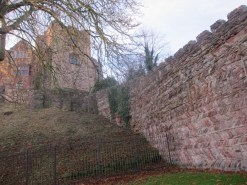
Motte and bailey Tamworth Castle © Adèle Emm

All mod cons.   Good view. Spacious and secure living space.  Long drive with plentiful parking. Reasonable rent.

Do you fancy this?  Fabulous estate-agent lingo for – guess where?  Tamworth Castle.  Yes, you too could be ‘Lord of the Manor’ in 1861.

Originally built circa 1090 as a motte and bailey castle possibly by William the Conqueror’s steward Robert de Spencer  (an ancestor of Diana Spencer aka Princess Diana), it was owned by a succession of families; the Ferrers, Shirleys, Comptons and Townshends.  In the middle of the eighteenth century, the Townshends updated and modernised the castle (which meant making it look older and more fairy-tale like!) spent a fortune and, in a nutshell, by the middle of the nineteenth century, had to rent it out.

In 1861, 42 year old gardenerJohn Asbury and his wife, Jane, both Tamworth born, lived here. Their neighbours were a motley bunch of horse drivers, cotton weavers, servants and coal miners – not at all the upper echelons of society…

The Cooke’s were definitely kings of the castle. © Adèle Emm

Fast forward ten years and the tenants were  the Cooke family.  Thomas, a 50 year old widower, was a wholesale clothier and landowner employing 1000 hands. Living with him were his four children plus footman, cook and housemaid.  His neighbours  down the hill were not-so-toffee-nosed miners and coachmen.   In 1881, Thomas is still slumming it up at the Castle and the records are more enlightening and certainly easier to read. Aged 60, he is a tailor and clothier ‘employing 650 hands and farmer of 220 acres employing 8 men and 5 boys.’    His unmarried daughter and two sons (who worked in the family business) still lived with him and, ministering to their every needs, were the cook and two housemaids.

A clothier, by the way, could either be a glorified tailor, draper, running a shop or a man who owned factories making cloth and/or clothes.  Not having done much research on this particular family, I suspect he owned a large tailoring company.  I would love to hear from any descendants and update this blog.

In 1897, the Castle was sold to Tamworth Corporation for £3,000.  Two years later it became a museum and was opened to the public.  Sorry, but you missed your chance to live like a king.

Sold to Tamworth Corporation in 1897, this is now a museum open to the public © Adèle Emm

Street traders in Albania

IMG_0216 (640x395)

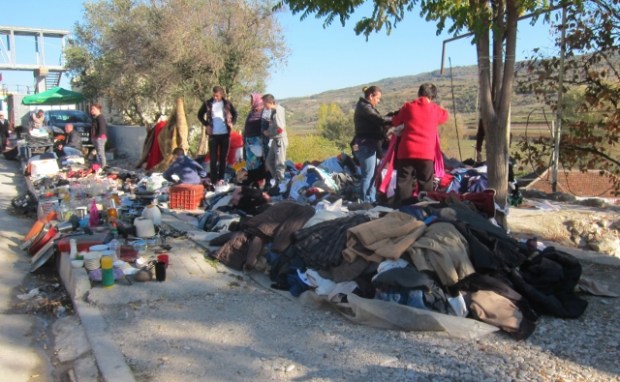
A street market on the road to Byllis, Albania © Adèle Emm

I’ve just returned from a holiday in Albania and, as always, am intrigued on how a country’s economics change.  There’s a huge market for second hand clothes in Albania especially for  villages  which are miles away, both physically and transport-wise from larger towns and cities. On the road to the ancient city of Byllis, we stopped, impromptu, at a street market where the main commercial commodity was not local food (most customers were semi or entirely self-sufficient from a small holdings or garden) but clothing and shoes strung out on racks or laid higgledy-piggledy on the verge of the road.  I wasn’t convinced that just left shoes were up for sale…

And this, of course, is how those in the British Islands who couldn’t afford new clothes in past times clothed themselves.  The better-off poor purchased second-hand clothing, the more destitute and desperate, third/fourth hand or rags. A fellow traveller told me that unwanted clothing we sell for £4 per 10 kilos at home in England is destined for just such a destination.

There is nothing new under the sun…

Fake News. John Emm was the bosun on HMS Victory at the Battle of Trafalgar

The death of Nelson on HMS Victory. Coloured engraving by J. Heath, 1811. Wiki Commons

Following the tragic death of Susanna Emm, 89, in a house fire at 14 Minerva Street, Hackney, the Shoreditch Observer 8 June 1878 reported she was ‘the widow of the boatswain on board the Victory when Nelson received the fatal shot.’   Wow!  A distant relative of mine, John Emm (1786-29 February 1872) was at the Battle of Trafalgar, 1805. Firstly, I emailed my Emm relatives; secondly I checked facts.

The bosun of HMS Victory at the Battle of Trafalgar was William Wilmet, famous for firing the portside 68 pounder gun into the side of the French ship Bucentaure killing 197 men including the French Captain and injuring 85 more.

I searched  www.nationalarchives.gov.uk/trafalgarancestors/advanced_search.asp   to find my John Emm. Not a dicky bird.  But John Brimm, same age, from the same town in Hampshire was on HMS Dreadnought and it wouldn’t be the first mis-transcribed Emm so I toddled down to Kew to view the original records. John Brimm was definitely John Brimm.

It’s a lot easier to double check facts today; after all, there was no internet and no National Archives. If  I’d been the unnamed 1878 journalist, I’d have been cock-a-hoop to find a former real-life hero (albeit a dead one) on my patch.

There were over 110,000 men in the 1805 British Navy although only 18,000 of them were employed at the Battle of Trafalgar (see the link above to find your ancestor).   Perhaps John was in the navy but not at the battle.  I finally found a resettlement order where Bethnal Green’s Poor Law Guardians were trying to return my impoverished John Emm to Hampshire. His statement said he had been pressed into the Royal Navy when he was a youth.

It just goes to show that fake news has been around a long time…